
What Actually Makes an Influencer Campaign Work in 2026?
Key Takeaways
- Most influencer campaigns operate like lotteries; sending products, buying posts, and hoping for viral hits, while winning brands in 2026 run systematic “growth engines” with predictable, compounding results.
- Plateaued results stem from optimizing for vanity metrics like reach and engagement rather than attributable revenue, customer lifetime value, and creative learnings.
- The smartest brands treat influencers as a full-funnel channel with systematic creator selection, narrative strategy, full-funnel measurement, and always-on optimization.
- Three 2025–2026 shifts have made old playbooks obsolete: TikTok’s algorithm volatility reducing organic reach by up to 40%, user-generated content outperforming studio assets by 25-30% in cost-per-acquisition, and AI-powered audits exposing fake followers across 20-30% of mid-tier creators.
- This article shows how to rebuild influencer marketing into a predictable engine—and when complexity suggests partnering with an influencer marketing agency like InfluencerNexus.
Why So Many Influencer Campaigns Still Fail in 2026
You’ve watched creator costs climb 25% year-over-year. Your engagement rates remain flat at 1-3%. And when your CMO asks what influencer actually drove last quarter, you’re piecing together screenshots and approximations. You’re not alone; this is the reality for most brands running influencer programs today.
The core problem is structural. Most brands are playing a lottery: sending free products to a handful of creators, buying one-off posts, and hoping something goes viral. This contrasts sharply with an engine approach, a repeatable system that builds predictable outcomes through strategic creator selection, narrative-driven content, and rigorous measurement.
The numbers reveal the gap. Global spending on influencer marketing is projected to surpass $30 billion by 2026, with brands allocating 15-20% of total marketing spend. Yet average return on ad spend remains stagnant at 2-3x for most programs, far below paid social benchmarks of 4-5x.
Why the disconnect? The most common failure modes include:
- Misaligned goals: Chasing broad reach without a single primary business objective
- Poor creator-audience fit: Prioritizing follower count over audience demographics and purchase intent
- No narrative strategy: Feature-dump posts that achieve 2x lower view-through rates
- Platform over-dependence: 60% of brands allocate 80% of their budget to TikTok despite reach drops
- Superficial reporting: Measuring impressions instead of incrementality
At InfluencerNexus, we’ve audited dozens of underperforming programs and rebuilt them into engines. What follows is the framework we use to turn lottery-style spending into predictable growth.
The Lottery vs. Engine Framework: How Smart Brands Run Influencer in 2026
Lottery campaigns are ad-hoc, high-risk bets on individual posts with unpredictable outcomes and no compounding assets. Engine campaigns are repeatable systems prioritizing decision quality, audience, matched creator selection, briefed storytelling, full-funnel KPIs, and content libraries for paid amplification.
In lottery mode, goals chase a broad reach without baselines. Creator selection happens by follower count alone. Briefs demand generic product mentions. Measurement focuses on likes and views. In engine mode, goals tie to revenue targets like 15% new customer growth. Creators are chosen via audience overlap scores above 70% and historical ROAS. Briefs provide narrative arcs with flexible execution. Measurement tracks incremental sales via UTMs, promo codes, and marketing mix modeling.
Engine campaigns treat influencers as a full-funnel channel, awareness, consideration, conversion, and retention, not just a one-off exposure tactic that brands bring creators into without strategic intent.
Consider a DTC beauty brand that moved from one-off TikTok posts generating 1.5x ROAS to an engine with 50 micro influencers, generating 500 UGC assets repurposed in Meta ads for 4.2x ROAS and 25% CAC reduction. Similarly, a productivity app scaled from sporadic influencer collaborations to quarterly cohorts, lifting app installs 40% via YouTube long-form plus short-form clips in ads.
Diagnostic questions to identify your current state:
- Can you predict next quarter’s influencer-driven revenue within a 15% range?
- Do you have creator performance tiers that guide renewal and scaling decisions?
- Are you repurposing more than 20% of creator content into paid media?
If you answered “no” to any of these, you’re operating closer to the lottery than the engine.
The 6 Non-Negotiables of a High-Performing Influencer Campaign in 2026
Regardless of industry or platform, winning influencer campaigns share six foundations that InfluencerNexus bakes into every engagement. These aren’t optional enhancements; they’re structural requirements.
The six non-negotiables are:
- Precision goal-setting
- Audience-first creator selection
- Story-led messaging
- Content as an asset
- Integrated media strategy
- Ruthless measurement and iteration
Missing even one of these typically pushes a campaign back toward lottery mode. In audits, we’ve seen single gaps halve efficiency. The following sections walk through each element with practical guidance for in-house teams.
As you read, map each non-negotiable to your current playbook and note the gaps.
1. Precision Goal-Setting (Beyond “Let’s Get Reach”)
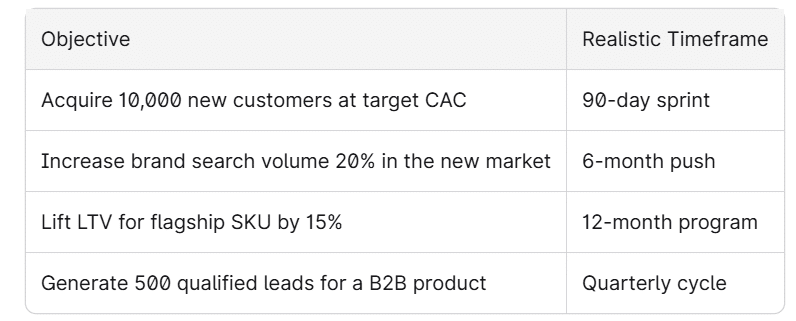
Every 2026 campaign must start with a single primary business objective. Not three priorities. Not “awareness and sales.” One measurable outcome that the entire program serves.
Concrete objective examples and timeframes:
Your pre-brief checklist:
If you can’t define success in one sentence and one primary KPI, the brief isn’t ready. AI forecasting models trained on past creator performance can help set smarter, more realistic targets—predicting outcomes based on category benchmarks like beauty’s 3x ROAS floor.
2. Audience-First Creator Selection (Not Follower-First)
In 2026, the only meaningful question is “Does this creator’s audience look like our best customers?” rather than “How big is this creator?”
The data points you should demand include audience geography, age/gender match (target 80% overlap), purchase intent signals from affiliate history, historic conversion metrics, and content category relevance. Research shows 70% of micro influencer audiences match target buyer profiles versus only 40% for macro influencers.
InfluencerNexus uses AI-powered influencer audits to detect fake followers, engagement pods, and misaligned audiences across Instagram, TikTok, YouTube, and emerging platforms. These audits flag the 20-30% of mid-tier creators affected by fake engagement through machine learning analysis of comment authenticity, timing patterns, and audience overlap.
Portfolio construction guidance:
Build portfolios mixing 70% nano influencers and micro creators for trust and UGC volume (these deliver 4-8% engagement rates) with 30% mid-tier partners for reach and storytelling.
Red flags to watch:
- 50%+ follower growth spikes in short periods
- Engagement rate under 2% with generic comments
- Recent posts promoting competing products
- Comment timing patterns suggesting pods
The right influencer isn’t the biggest one, it’s the one whose audience matches your target audience with genuine purchase intent.
3. Story-Led Messaging (From Product Features to Narrative Arcs)
2026 audiences quickly skip anything that feels like traditional advertising. Successful campaigns need a narrative arc anchored in the customer’s life, not just the product’s features.
At InfluencerNexus, we build a central “campaign story”, transformation, challenge, or lifestyle shift—then let creators interpret it through their own lens. The difference in performance is stark: feature-list posts achieve 1.8% CTR while story-arc content hits 4.2%.
Narrative examples by category:
- Health & wellness: Challenge-to-victory journeys (30-day transformation)
- Beauty: Confidence unlock moments (before/after identity shifts)
- Productivity apps: Chaos-to-control narratives (day in the life)
- Home goods: Space transformation stories (revealing process)
Your briefs should specify non-negotiable brand claims and disclosures while leaving space for creators to use their own language, humor, and filming style. This balance between brand values and creator authenticity is what separates forgettable posts from engaging content.
Multi-touch storytelling, teaser, reveal, “day in the life,” follow-up results, consistently outperform single “hero” posts, boosting completion rates by 50%.
4. Content as an Asset (Not Just a Post)
In 2026, the real ROI often comes from how influencer content is repurposed across paid and owned channels, not just its organic performance. We estimate 60% of the value comes from whitelisting into ads, landing pages, and emails.
Common reuse scenarios:
- Paid social ads (Meta, TikTok, YouTube)
- Landing pages and PDPs
- Email flows and SMS campaigns
- Retail media and Amazon listings
- Sales enablement decks
Securing the right content usage rights and durations upfront in contracts enables cost-effective whitelisting and long-term use. Build “creative libraries” from every campaign, dozens of hooks, formats, and angles that can be performance-tested via paid media.
A skincare brand we worked with cut cost-per-acquisition by 25% simply by swapping studio ads for top-performing creator UGC in Meta campaigns. The content costs approximately $0.08 per asset versus $5 for studio production. This shift from viewing creator content as disposable posts to treating it as strategic assets changes the economics entirely.
5. Integrated Media Strategy (Influencer + Paid + Owned)
Siloed influencer campaigns running organic-only are increasingly inefficient in 2026 due to algorithm volatility and fragmenting attention. TikTok’s algorithm changes have reduced organic reach by up to 40% for non-trending content year-over-year.
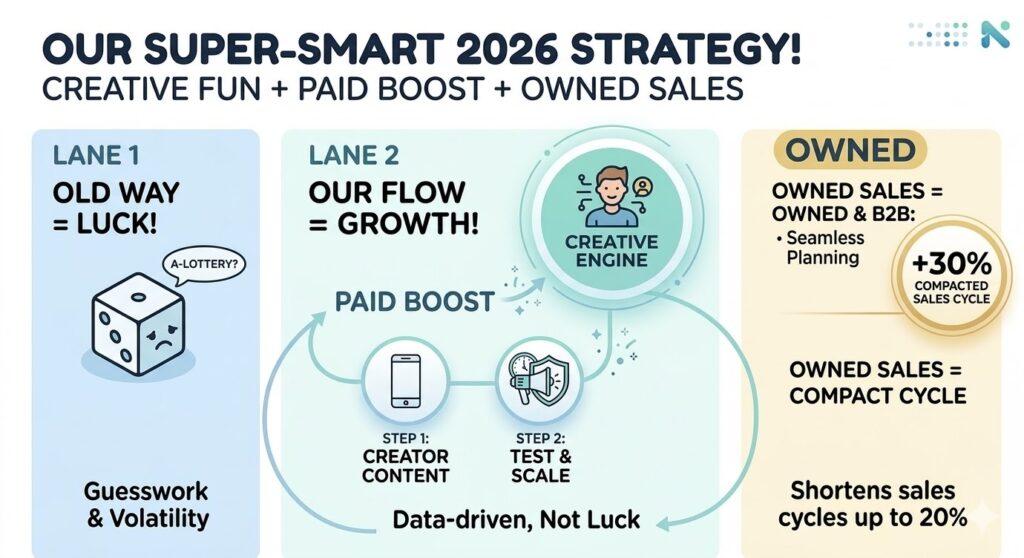
InfluencerNexus treats influencers as the “creative engine” that fuels performance media—especially on Meta, TikTok Ads, YouTube Ads, and retail media networks.
The concrete flow:
- Creator content goes live organically
- Top performers identified via 48-hour data (engagement, hold rates)
- Top 10% scaled via paid whitelisting and dark posts
- Targeting expanded to specific audience segments
- Scaling to 5-10x original reach for winners
Coordinating influencer calendars with brand launches, email pushes, PR drops, and in-app experiences creates 30% compounding lift. For B2B and higher-consideration brands, integrate creator content into webinars, LinkedIn campaigns, and nurture sequences to shorten sales cycles by up to 20%.
6. Ruthless Measurement and Iteration
In 2026, you can’t call an influencer a “channel” unless you can attribute influence to outcomes using first-party data, UTMs, unique codes, and post-purchase surveys.
Key metrics by objective:
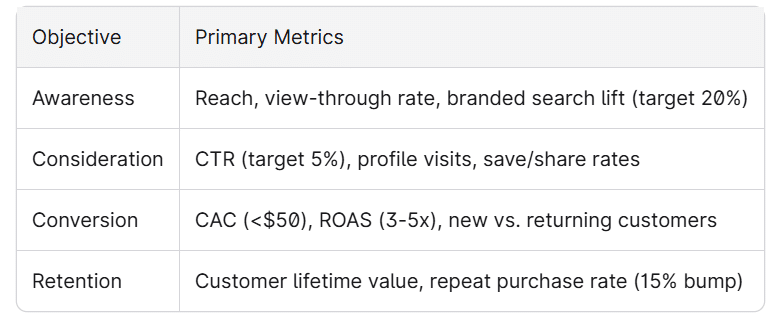
InfluencerNexus combines platform analytics, e-commerce/CRM data (Shopify, Klaviyo, HubSpot), and marketing mix modeling to understand true incremental impact.
The iteration loop:
Run 2-week sprints. Pause the bottom 20% of creators or concepts. Reallocate budget to the top 20%. Test 3-5 new hooks each month. This “test, learn, scale” discipline is what permanently moves a program from lottery to engine, delivering 40% year-over-year efficiency gains.
From Campaigns to Systems: Architecting an Influencer Growth Engine
One-off campaigns are useful but insufficient. Serious brands in 2026 operate year-round influencer systems with defined processes, not quarterly scrambles.
Core components of a growth engine:
- Pipeline of new creators (monthly onboarding 10-20)
- Stable of long-term partnerships (6-20 core ambassadors)
- Creative testing framework with documented learnings
- Usage rights strategy for maximum content leverage
- Integrated reporting cadence tied to business outcomes
InfluencerNexus builds these engines in 90-day sprints that roll up into 12-month roadmaps, aligning with product launches, seasons, and influencer marketing budget cycles.
Recommended operational rituals:
- Monthly creator performance reviews (tier and renew top 30%)
- Quarterly strategy retros adjusting creator and format mixes
- Annual audits to reset strategy based on influencer marketing trends
When complexity grows, multiple markets, dozens of creators, multi-channel attribution, partnering with an agency becomes more efficient than in-house management.
Structuring Always-On Creator Relationships
2026 favors hybrid structures: a core ambassador group of 6-20 creators for continuity plus rotating cohorts for testing new niches, formats, and markets.
Example cadence structure:
- Monthly: 4 Reels/TikToks from core ambassadors
- Quarterly: YouTube integrations with top performers
- Seasonal: Campaign bursts around product launch campaigns
- Occasional: Co-created drops or limited editions
Creator continuity delivers 2x better brand recall, higher trust, better content quality, and lower briefing overhead. Long-term creator partnerships reduce costs by 50% compared to constant one-off negotiations.
InfluencerNexus uses performance data to “graduate” high-performing one-off collaborators into ambassador or co-creation campaign roles. Contract structures typically include a base retainer ($1k-5k/month) plus a performance bonus (10% revenue share for affiliate campaigns) and early access to products.
Building a Repeatable Creative Testing Framework
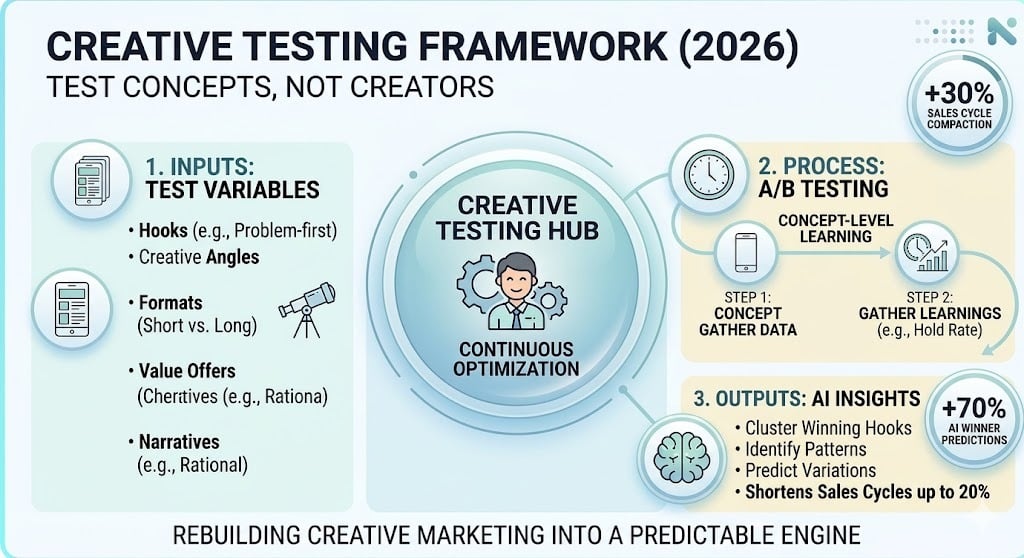
A modern engine continuously tests hooks, angles, formats, and offers using creator content as the main testing ground.
Test variables to systematically explore:
- Short vs. long-form content
- Problem-first vs. solution-first hooks (problem-first shows 2x CTR)
- Price-led vs. value-led offers
- Emotional vs. rational narratives
The key insight: capture learnings at the concept level, not just the creator level. This means brands learn which ideas move numbers, not just which people perform well.
Document learnings in a centralized “creative insights” repository that performance and brand teams can both access. AI-assisted analysis in 2026 can cluster winning hooks, identify patterns in top-performing content, and recommend new variations, predicting winners with 70% accuracy.
Channel & Format Choices That Actually Convert in 2026
Major 2025–2026 shifts have reshaped the landscape: TikTok reach has become more volatile, Reels have stabilized at 3-5% engagement rates, YouTube mid/long-form maintains strong 10-15% completion for consideration, and LinkedIn plus podcasts are growing for B2B.
There’s no single “best” platform. The right mix depends on category, ticket size, and sales cycle. But patterns emerge across InfluencerNexus clients.
Role by channel:
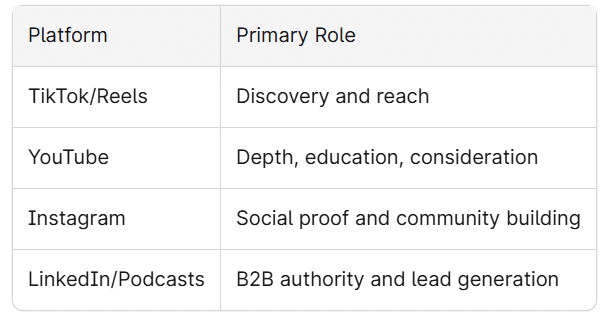
Avoid single-platform risk. Design campaigns where the same narrative appears in tailored forms across 2-3 primary platforms. Fashion brands, fitness brands, and e commerce brands all benefit from this multi-platform approach that reaches new audiences through different content types.
Short-Form Video as the Default, Not the Only Bet
In 2026, short-form vertical video (Reels, TikTok, Shorts) is the baseline for attention. But saturation means quality narrative and hook discipline are critical; not every post breaks through.
Anatomy of high-performing short-form:
- Strong 1-2 second hook (before viewers scroll)
- Product visibility by second 3
- Quick pacing throughout
- Explicit call-to-action at the end
- Platform-native behavior (speak to camera, trending sounds used judiciously)
Format creator content so it can be repurposed for ads. InfluencerNexus benchmarks performance against category norms, killing content with a hold rate under 50% and scaling content above 80%.
Static content, carousels, and Stories still matter for product detail, FAQs, and driving website traffic and clicks—achieving 2x click rates when combined with short-form video.
Long-Form Content for Consideration and High-Ticket Offers
For categories like B2B SaaS, health, finance, and high-ticket consumer products, long-form YouTube, podcasts, and LinkedIn posts are often where decisions get shaped. Celebrity influencers and mega influencers often excel here due to their established credibility.
Effective long-form collaboration structures:
- In-depth product reviews with honest assessment
- “Day in the life” use cases showing real integration
- Tutorial content demonstrating value
- Webinars with Q&A components
- Case-study style narratives with measurable outcomes
InfluencerNexus integrates long-form with performance media: taking highlight clips into paid ads and embedding full videos on landing pages for warmer traffic.
Example: A productivity SaaS tool used creator-led YouTube tutorials (10-15 minute deep dives) plus retargeting ads featuring 30-second clips. The full-funnel flow lifted funnel completion by 25%. Long-form also supports SEO when properly titled and tagged, driving long-tail discovery and boosting sales.
Measurement, Attribution, and Proving ROI to Your CMO
CFO and CMO scrutiny has intensified as CAC rises across paid channels by 20%. Every influencer dollar now requires justification beyond vanity metrics.
InfluencerNexus approaches measurement by combining last-click data (40% weight), post-purchase surveys (20% weight), view-based attribution, and marketing mix thinking. This creates a realistic picture rather than platform-inflated numbers.
Tools and tactics available in 2026:
- UTM parameters for source tracking
- Personalized promo codes per creator
- Landing pages per creator (15% lift in attribution accuracy)
- Affiliate dashboards with real-time data
- Integration with analytics platforms (GA4, Shopify, HubSpot)
Not every campaign should be held to the same standard. Launch campaigns, evergreen content engines, and long-term ambassador programs have different measurement horizons. Use benchmark ranges (target CAC bands, content cost per asset, ROAS thresholds) instead of chasing a single “perfect” number.
What to Track at Each Stage of the Funnel
Metrics by funnel stage:
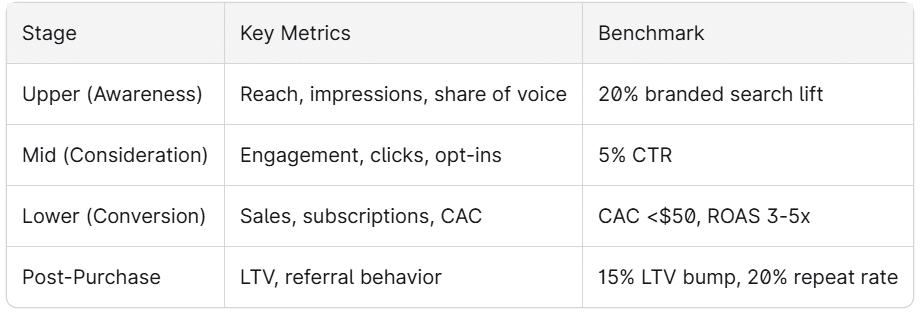
For DTC beauty, focus on immediate sales and repeat purchases. For subscription apps, track trial-to-paid conversion over 30-60 days. For B2B SaaS, measure qualified leads and pipeline influence over 90+ days.
First-party data has become more valuable as privacy shifts continue. Rely on owned measurement (site analytics, CRM) rather than solely platform-reported numbers. For mature brands needing board-level proof, incrementality tests via geo-holdouts show 25-40% true lift from influencer activity—critical for proving that influencer marketing works.
Turning Insights into Next-Quarter Strategy
Data is only useful if it changes next quarter’s plan. Which creators get renewed? Which narratives get expanded? Which formats get more budget?
Simple decision framework:
- Scale: Top 20% of creators and concepts get 2-3x budget
- Iterate: Middle 60% get refined briefs and one more cycle
- Sunset: Bottom 20% get paused or replaced
Cross-team reviews (brand, performance, content, e-commerce) should align on which influencer learnings influence broader marketing and product strategy. InfluencerNexus runs quarterly business reviews with clients to convert campaign data into roadmap decisions and budget recommendations.
This discipline transforms influencers from an experimental line item into a strategic growth lever that brand partners rely on.
When to Bring in a Specialist Partner Like InfluencerNexus
Many in-house teams are stretched thin managing multiple channels, internal reporting, and stakeholder demands. Building an influencer engine requires specialized expertise that’s difficult to develop while running day-to-day operations.
Signals it’s time to partner:
- Managing 20+ creators across platforms
- Entering new markets with local influencers and local creators
- Struggling with multi-channel attribution
- Needing integrated paid social support for UGC campaigns
- Preparing for a major 2026 product launch
InfluencerNexus works by auditing existing programs, designing engine architecture, and running end-to-end campaigns—strategy, sourcing, briefs, production, paid amplification, and analytics. We blend AI-driven workflows for discovery and analytics with senior strategists who understand storytelling, category nuances, and compliance requirements.
Ready to move from lottery to engine? Book a consultation where we’ll review your current program and map a path to predictable influencer-driven growth.
What an InfluencerNexus Engagement Looks Like in Practice
Typical 90-day engagement structure:
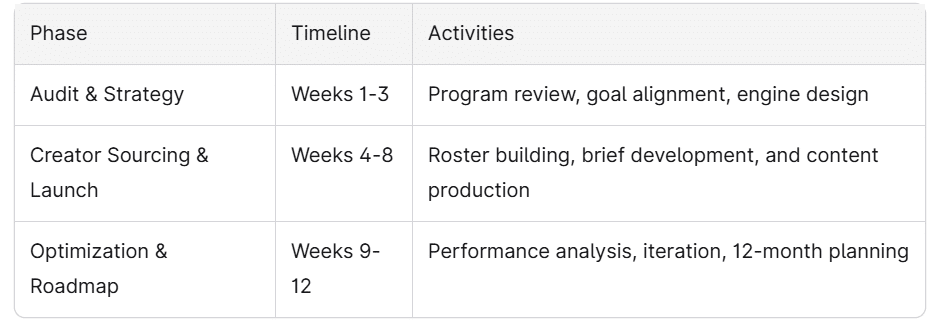
Client archetypes we serve:
- Mid-market beauty brand: Struggling with scattered creator content and no paid integration. Delivered 4x ROAS through UGC campaigns feeding Meta ads.
- VC-backed app: Needed rapid user acquisition. Lifted installs 40% via structured YouTube plus short-form strategy.
- Consumer electronics brand: Required multi-channel coordination across YouTube, TikTok, and retail media. Built ongoing relationships with creators that drove measurable outcomes.
Deliverables include:
- Campaign strategy deck
- Vetted creator roster (we vet influencers thoroughly)
- Content calendar with multiple creators
- Usage rights matrix
- Reporting dashboards tied to ad spend and revenue
- Quarterly testing plan
InfluencerNexus can plug into existing internal teams and agencies, acting as the influencer “engine room” rather than replacing your brand partnerships structure.
Next step: Schedule a strategy call and bring your current metrics, past campaign examples, and 2026 business goals. We’ll show you exactly where the gaps are and how to close them.
FAQ
These FAQs address edge cases and concerns senior marketers often raise after understanding the engine framework. Answers cover operational details not fully unpacked above, budgets, timelines, global expansion, and when to build versus partner.
How much do I realistically need to budget for an influencer “engine” in 2026?
Budget ranges vary by company stage. Testing and UGC-heavy programs typically require under $25k/month. Multi-creator engines with paid amplification run $25k–$100k/month. Mature brands running multi-country campaigns often invest six-figure quarterly budgets.
Budget should cover both creator fees and media amplification, plus internal or agency time for strategy and analytics. A useful rule-of-thumb: influencer should represent at least 10–20% of paid social budget if treated as a primary growth channel. InfluencerNexus helps clients phase investment—starting with a pilot to prove unit economics before scaling.
How long does it take to see measurable results from a more structured influencer program?
Most brands see early directional signals within the first 30–60 days, including content performance data and early sales attribution. More stable patterns, reliable ROAS ranges, and predictable creator tiers typically emerge by 90 days.
Awareness and brand perception goals may take 3–6 months to fully quantify through brand lift studies and search trend analysis. We recommend committing to at least two consecutive 90-day cycles before making major strategic changes. Some quick wins, like swapping creator UGC into paid ads, can impact paid efficiency within a few weeks.
Can I run an influencer engine globally, or should I focus on one market at a time?
While global influencer engines are possible, most mid-market brands see better results focusing on 1–2 priority markets before expanding. Local nuance matters significantly: regulations, languages, cultural references, platform dominance, and creator norms differ by region.
InfluencerNexus often pilots in a core market (US, UK, or DACH), then clones the winning playbook into secondary markets with local creators and local businesses in context. Align market sequencing with your logistics capabilities, product-market fit, and internal support capacity.
What if my category is highly regulated can an influencer still work?
Regulated categories require tighter compliance review, clear disclaimers, and sometimes slower approval cycles. However, influencers can be powerful when focused on education, process transparency, and expert voices rather than pure hype.
InfluencerNexus builds compliance into the workflow: pre-approved claim banks, review steps, and creator training on permissible language. Many health, wellness, and fintech brands are running effective influencer engines in 2025–2026 with proper guardrails. The key is working with creators who understand the constraints and can create content that builds trust without crossing lines.
Should we build this in-house or partner with an agency like InfluencerNexus?
In-house makes sense for smaller creator portfolios, single-country focus, and teams with strong internal performance and creative capabilities. You maintain direct control and build institutional knowledge over time.
An agency becomes valuable when scale, complexity, and executive expectations increase—dozens of creators, multiple markets, deeper analytics requirements, and tight integration with paid media. InfluencerNexus operates as a flexible partner: we can design the engine, run it fully, or co-own it with in-house teams during a transition period.
A low-risk first step is an audit or pilot campaign to evaluate fit and quantify upside before fully committing. This lets you measure success before expanding the influencer partnership.