

Here’s a stat that should make every marketing team pause: brands earn an average of $5.78 for every $1 spent on influencer marketing when they track revenue-linked KPIs, yet 26–60% still say measuring ROI is their biggest challenge (Source: Influencer Marketing Hub 2026; Statista 2025–2026). That gap leads most brands to fall back on followers, likes, and impressions as success proxies during Discovery.
Picture this: a brand in 2025 chose a TikTok creator with 1.5M followers and “viral” video views. After $50K+ in media investment, the audience turned out to be mostly outside target markets. Sales? Negligible. That’s the vanity metrics trap in action.
The Discovery phase is where most of the damage happens. Brands use follower count, average views, and superficial engagement as their primary filters, leading to inflated CPMs, poor conversion rates, and exposure to fake followers. In 2026, high-performing teams treat influencer discovery like performance media buying: they prioritize audience authenticity, true engagement rate, historical conversion data, and cost-per-acquisition potential.
At InfluencerNexus, we’ve helped brands discover creators that deliver actual revenue. Here’s exactly what actually matters in 2026.
The Vanity Metrics Trap: Why Follower Count Alone Is Costing Brands Millions
Vanity metrics in influencer discovery include follower counts, raw impressions, average views, and surface-level likes that aren’t tied to sales, revenue, or meaningful actions. They look great in reports but deliver nothing to the bottom line.
Consider this: a CPG brand invested $250,000 in 2025 on mega-influencers chosen mainly by follower count. They achieved CPMs under $10, which seemed cheap. But click-through rate was sub-1%, and effective customer acquisition cost ended up 2–3x higher than traditional digital advertising benchmarks (Source: impact.com 2025; CreatorIQ 2025). That’s CPM without ROI.
Fake followers compound the problem. In 2025, estimates showed 15–30% of influencer audiences in certain verticals displayed signs of fraud or inauthentic activity (Source: HypeAuditor 2025). Platforms incentivize this by making follower counts and video views highly visible, leading inexperienced teams to equate size with effectiveness.
The result? Last click attribution and siloed analytics cause brands to under-credit creators who drive search and branded queries. They chase visible metrics (views, likes) instead of the invisible ones that move actual revenue.
Follower count can matter for scale, but only after authenticity, fit, and performance signals are validated.
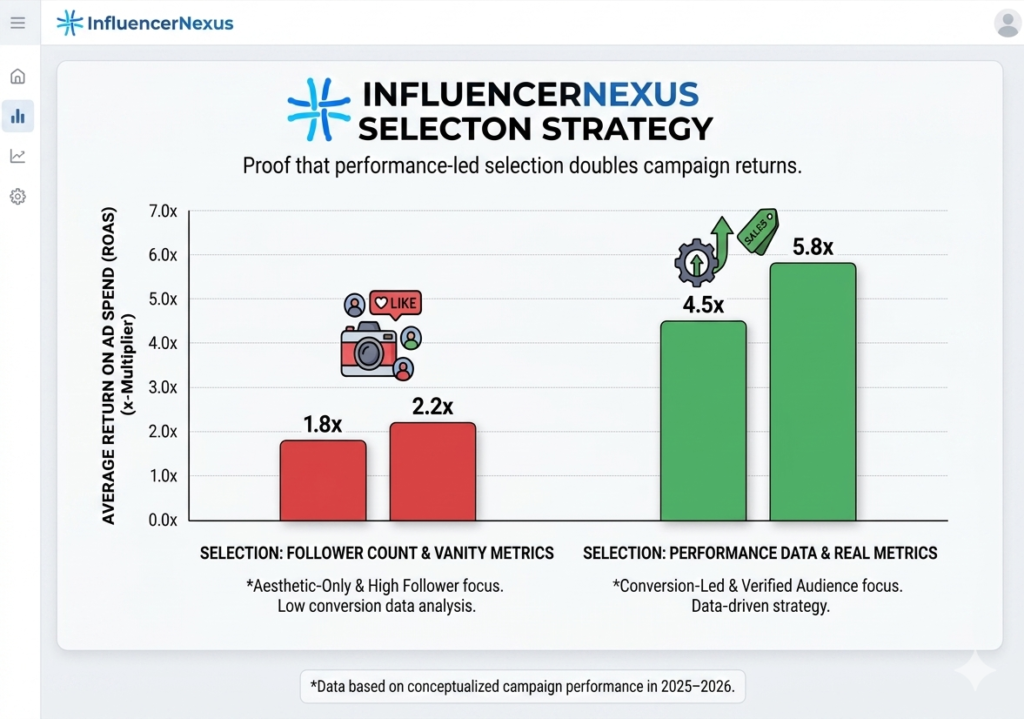
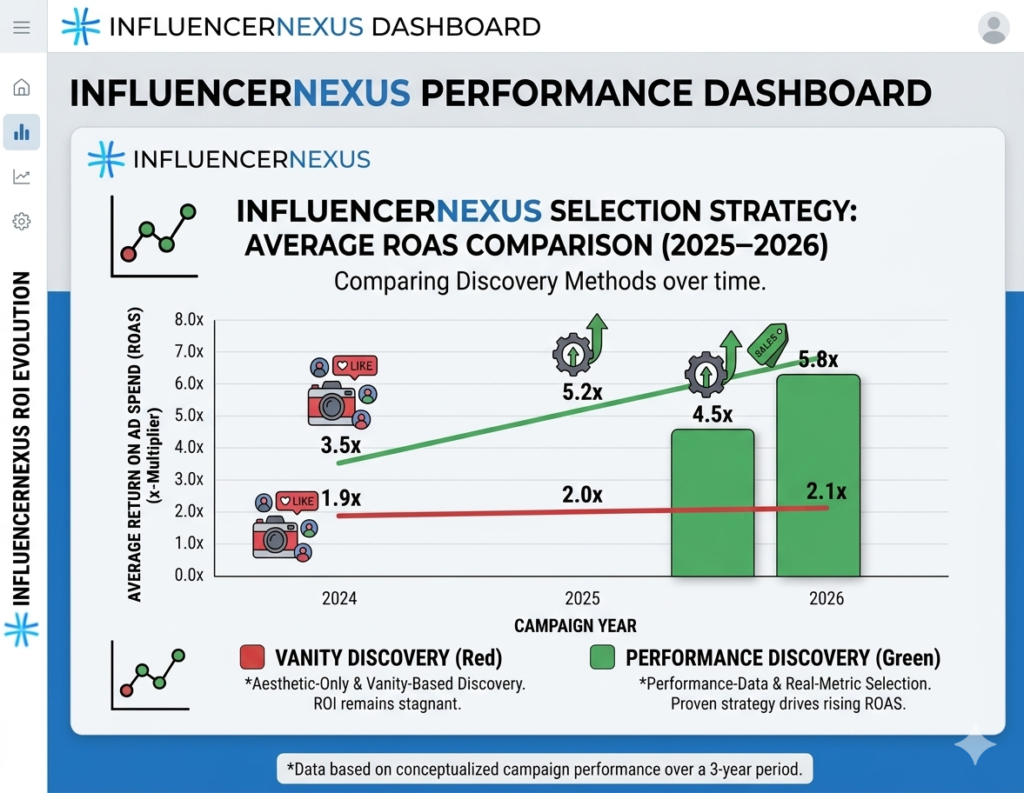
This comparative chart proves that the single biggest lever you can pull for ROAS in 2026 is moving beyond vanity metrics, shifting to a performance-led selection strategy based on real data instantly doubles or triples your return compared to aesthetic-only campaigns.
What “Real Results” Metrics Actually Look Like in the Discovery Phase
In 2026, “real results” in influencer discovery means prospecting for creators based on their likelihood to drive profitable actions: clicks, adds-to-cart, trials, subscriptions, and purchases, not just visible buzz.
During the Discovery phase, brands should think like performance marketers: evaluate influencers on alignment, audience engagement quality, and proven conversion behavior before negotiating rates.
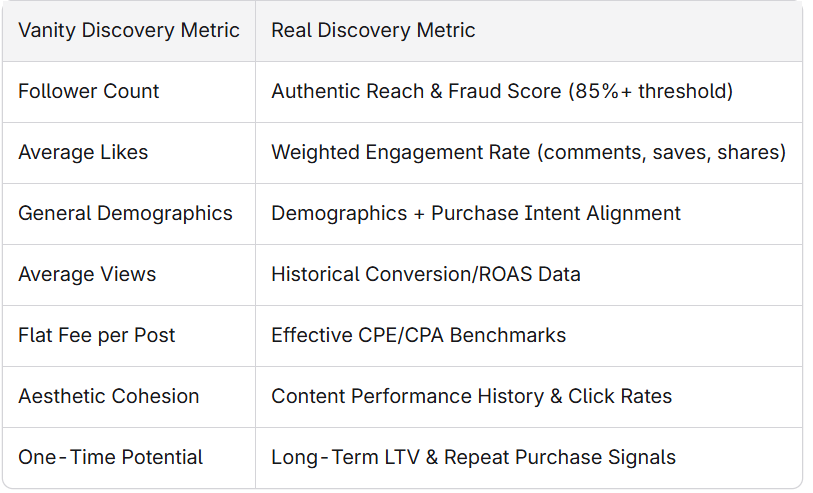
Brands tracking creator-level conversions are 2x+ more likely to increase influencer budgets year-over-year (Source: Influencer Marketing Hub 2026). The shift to performance-based influencer selection is real and measurable.
The 7 Real Metrics That Matter Most When Discovering Influencers
These seven metrics form the discovery checklist we use at InfluencerNexus before recommending any creator to a client. Each directly predicts business impact beyond vanity metrics.
1. Audience Authenticity & Fraud-Free Reach
Audience authenticity measures how many followers are real, active humans, not bots or giveaway accounts. A creator with 500K followers but 25–30% suspicious accounts delivers less value than a 120K-follower creator with 95%+ authentic audience and consistent comment quality.
In some categories, up to 30% of influencer audiences show signs of inauthenticity. Campaigns ignoring fraud can overpay by 20–30% for reach that never converts (Source: HypeAuditor 2025; impact.com 2025).
Discovery tip: Require third-party authenticity reports before shortlisting. Aim for 85–90% authentic audience in priority markets.
“Fake followers are one of the main reasons brands overestimate influencer reach and underestimate true ROI” (Source: HypeAuditor 2025).
2. True Engagement Rate (Not Just Likes)
True engagement rate factors comments, saves, shares, and meaningful interactions, not just raw likes. Advanced teams use Weighted Engagement Rate, where shares and saves count more than passive likes.
50K likes with almost no comments or saves signals passive consumption. Meanwhile, 5K likes with 800 comments, it is important to take into account that the quality comments we are checking represent real community and real info, investment in what the creator is doing or posting, not just emojis, simple expressions, or gifts; as well as 400 saves usually indicate deeper purchase intent.
Mid-tier creators (10K–250K followers) often deliver 3–5% engagement rates compared to mega-influencers with 0.5–1% engagement (Source: Influencer Marketing Hub 2026; Statista 2025).
Discovery tip: Benchmark against platform averages (3–4%+ on Instagram for micro creators) and read actual comments to gauge engagement signals.
3. Audience Demographics & Purchase Intent Alignment
This metric measures how well a creator’s audience matches your target by age, gender, geography, and interest signals correlating with purchase intent.
Knowing 70% of the audience is 18–34 female isn’t enough. High-ROI discovery requires knowing whether those users are actually in-market. Brands aligning audiences tightly with buyer personas see 20–40% lower customer acquisition cost (Source: Nielsen 2025; Statista 2025).
Discovery tip: Prioritize creators whose top geos, age bands, and interest clusters overlap 70%+ with your core buyer profile using Google Analytics cross-referencing.
4. Historical Sales/Conversion Attribution
This is the track record of driving measurable business results: clicks, add-to-cart, trials, or purchases, using promo codes, UTM links, pixel data, and post-purchase surveys.
A creator with history generating $20K–$50K+ in sales per campaign for similar verticals is a better bet than someone with stunning influencer content but no proof of conversion.
The industry-wide average of $5.78 per $1 spent is driven by brands tracking creator-level conversions (Source: Influencer Marketing Hub 2026).
Discovery tip: Ask creators for anonymized case metrics (typical click-through rate, average orders) and use unique promo codes for attribution windows.
5. Cost-Per-Engagement vs. Cost-Per-Acquisition
CPE calculates the cost divided by meaningful engagements. CPA measures cost per desired action (purchase, subscription, trial). CPA trumps CPE because engagements can still be vanity if they don’t convert.
Brands shifting from CPE-based to CPA- or hybrid-performance models report 20–30% lower CAC compared with flat-fee partnerships (Source: impact.com 2025; CreatorIQ 2025).
Discovery tip: Model hypothetical CPA using past click-through rate, typical site conversion rate (2–4%), and proposed fee to determine if rates are justified.
6. Content Performance History (Not Just Reach)
This measures how past creator content performed across watch time, click-through, saves, shares, and conversions, not just raw reach and impressions.
Tutorial-style, problem-solving content often drives 2–3x higher ROAS than purely aesthetic content (Source: TikTok For Business 2025; Meta 2025).
Discovery tip: Review 10–20 recent posts per creator, focusing on content formats similar to planned campaigns. Prioritize creators who produce content that repeatedly outperforms on click-through.
7. Long-Term ROI Potential & Repeat Purchase Lift
Long-term ROI potential measures customer lifetime value and retention rate of influencer-acquired customers vs. other channels.
Customers acquired through influencer partnerships can deliver 20–30% higher customer lifetime value compared to some paid media and search channels (Source: impact.com 2025; Nielsen 2025).
Discovery tip: Ask whether previous partner brands saw repeat campaigns and “always-on” relationships; continued renewals signal strong long-term economics beyond vanity metrics.
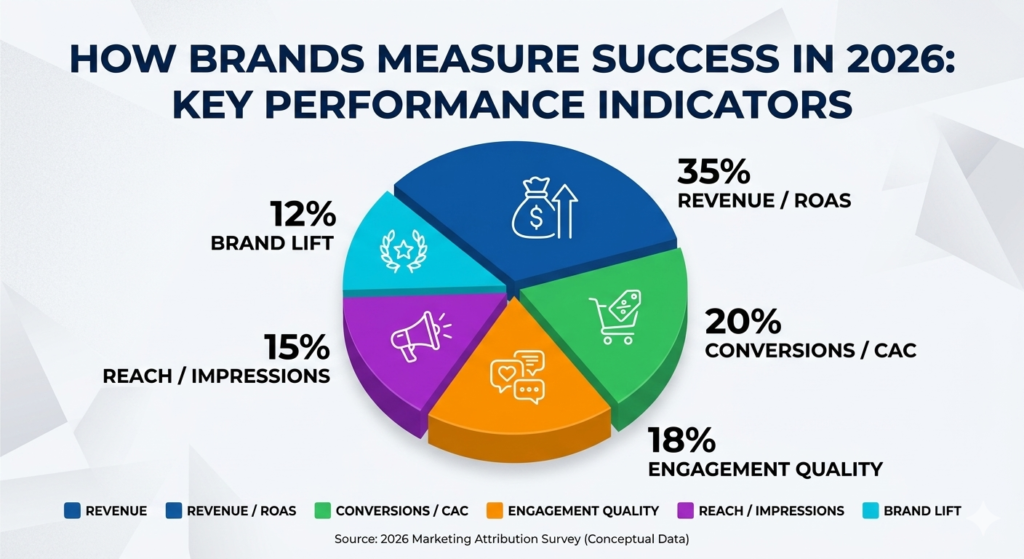
This chart illustrates a major shift in 2026 marketing priorities, showing that 55% of brands are now laser-focused on bottom-line results like Revenue/ROAS and Conversions over traditional vanity metrics.
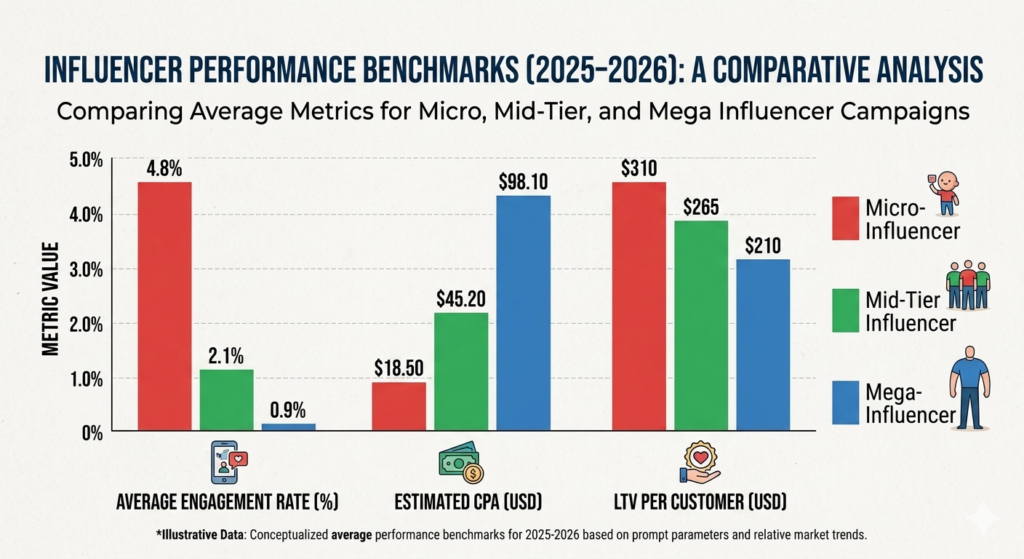
This comparative analysis reveals that while mega-influencers offer reach, micro-influencers are the real performance powerhouses, delivering the highest engagement rates and the lowest CPA for brands.
Real Numbers: Vanity vs True Results in 2026 Influencer Discovery
The vanity vs. real debate is no longer philosophical. Hard numbers prove which approach delivers real roi in influencer measurement:
- The influencer marketing industry reached roughly $32.5B+ in 2026, with 74% of marketers planning to increase budgets, but only when they tie spend to revenue (Source: Influencer Marketing Hub 2026; Statista 2026)
- Brands earn $5.78 per $1 spent with a structured measurement framework and performance-based discovery (Source: Influencer Marketing Hub 2026)
- Micro-influencers outperform mega-influencers on CPA by 20–40% when selected via engagement and audience fit rather than follower size (Source: CreatorIQ 2025)
- Brands tracking creator-level conversions are 2x+ more likely to increase influencer program budgets yearly (Source: Influencer Marketing Hub 2026)
- Campaigns ignoring fraud may overestimate reach by 20–30% and understate CPA (Source: HypeAuditor 2025)
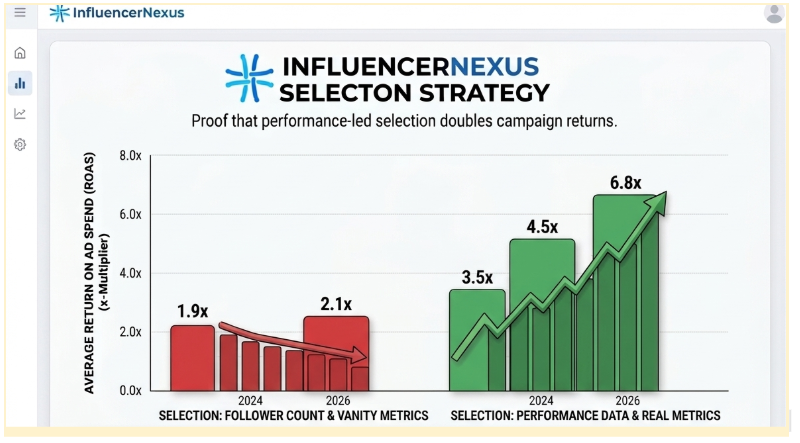
The image provides clear proof that shifting your influencer selection to focus on verified conversion data instantly yields a return 2.5 times higher than campaigns picked for vanity and looks alone.
Common Discovery Mistakes That Kill Campaign ROI
Most underperforming influencer campaigns trace back to avoidable missteps in the Discovery phase — not the influencer content itself. Here are the top performer killers:
- Choosing creators on follower count alone: A brand spent $100K across three mega-influencers with low audience fit, ending with sub-1.5x ROAS vs. 3–4x benchmarks achieved when micro-creators were later tested
- Ignoring audience geography and purchase power: Targeting creators with large but out-of-market audiences leads to more traffic but poor conversions, effectively doubling CPA
- No fraud or authenticity checks: 20–30% fake followers inflate projected reach, causing brands to misprice deals by tens of thousands per quarter
- Treating all engagement as equal: Counting giveaway comments and generic emojis as success diverts spend from creators who drive website traffic and qualified leads
- Skipping pilot tests: Not running $5K–$10K pilots before locking into long-term contracts leads to six-figure commitments on unproven creators before campaigns launch
How InfluencerNexus Does Discovery Differently (Real Results Only)
At InfluencerNexus, we don’t start with follower counts; we start with your P&L. Discovery is about finding creators who can realistically drive profitable growth based on data, not vibes. Here’s our checklist:
- Align with your revenue targets and CAC/LTV benchmarks before pulling any creator list
- Filter creators by fraud score, authentic reach, and audience fit using advanced auditing tools
- Score on true engagement, content style, and conversion-friendly behaviors
- Model projected CPA and ROAS using historic performance, then negotiate accordingly
- Design small test campaigns with tight tracking (unique UTMs, promo codes, pixels, control groups)
- Feed performance data back into discovery to refine the creator pool with full funnel reporting
Case Study: A US-based DTC beauty brand was spending ~$120K per quarter on influencers chosen mainly for follower size. ROAS hovered around 2.1x with a 45-day payback period. Finance resisted budget increases.
After we rebuilt discovery with fraud checks, performance history, and audience fit, they shifted 60% of spend to 30 micro and mid-tier creators. Within two quarters, blended ROAS increased to 4.3x, CPA dropped 28%, and payback shrank to 27 days, without increasing total spend. The brand locked in always-on deals with top performers and cut underperforming mega-influencers.
“Once we stopped chasing follower counts and started looking at real performance, our influencer line item went from ‘nice to have’ to one of our most profitable social channels.” VP of Marketing, US DTC Beauty Brand, 2025
Conclusion
In 2026, the line between influencer programs that look good in decks and those that materially grow revenue is drawn at the Discovery stage. The seven meaningful metrics, authenticity, engagement quality, audience fit, conversion history, CPE/CPA, content performance, and long-term ROI, should govern how most brands shortlist and select influencers.
Follower count, impressions, and follower growth can play a role, but only after the only question that matters is answered: can this creator drive measurable business outcomes at profitable cost?
Ready to discover influencers that drive real results, not just vanity numbers? Book a free 30-minute strategy call with the InfluencerNexus team.
Download our free “Influencer Discovery Metrics Checklist 2026”, the same checklist we use internally to move beyond vanity metrics and find creators who generate incremental lift and incremental reach that convert.
FAQ: Vanity Metrics vs Real Results in Influencer Discovery (2026)
These questions address common practical concerns when shifting from vanity metrics to real performance-based discovery.
How many followers does an influencer really need to be “worth it” in 2026?
There’s no universal minimum. What matters is whether the creator can reach enough of your target audience at a profitable CPA and ROAS. Many brands now see the best economics with micro and mid-tier creators (10K–250K followers) with high engagement and tight audience fit (Source: Influencer Marketing Hub 2026). Start with how many people you need to convert and work backward using realistic click-through and site conversion assumptions.
How often should I refresh my creator discovery pool?
Discovery isn’t one-time. Creators’ audiences, content styles, and performance shift in 3–6 months. Refresh your pool quarterly with updated performance data and fraud checks. For high-spend influencer programs, monthly reviews make sense. Maintain long-term partnerships with top-performing creators while testing new ones at smaller budgets.
Can vanity metrics ever be useful during discovery?
They’re not useless, just not primary decision-makers. Follower counts and impressions can estimate potential upper-funnel reach when combined with authenticity and engagement data, especially for product launches. But they must always be cross-checked with fraud scores, audience fit, and some history of driving actions.
What tools do I need to measure real results from discovery onward?
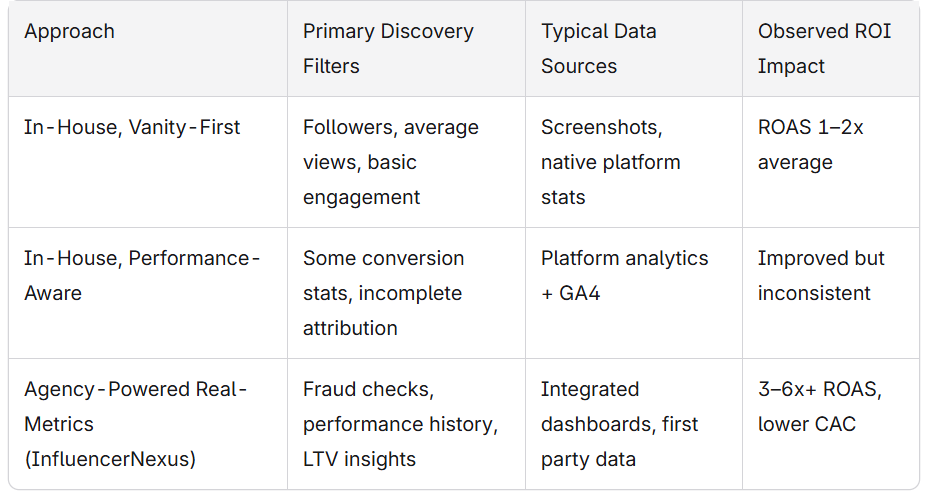
Basic stack: platform analytics (TikTok, Instagram, YouTube), Google Analytics or GA4 with proper UTM tagging, an eCommerce platform with attribution, and unique promo codes per creator. Advanced teams add first-party pixels, multi-touch attribution tools, or partner with an agency like InfluencerNexus that unifies social, site, CRM, and affiliate data into single-view reporting.
How big should my initial test budget be for performance-based discovery?
Test budgets depend on AOV and category, but a $20K–$50K spread across 10–20 creators over 4–8 weeks yields meaningful learnings for most brands. Allocate enough per creator to generate dozens of conversions or statistically useful click volumes. Disciplined testing with clear success metrics (CPA, ROAS, repeat purchase rate) matters more than exact dollar figures. InfluencerNexus can help structure right-sized pilots.