
Influencer Outreach Automation: Turning Manual Chaos into a Scalable Growth Engine
Key Takeaways
- Manual, one-by-one outreach caps influencer programs around €200k–€250k/month in spend; automation plus process discipline is what enables €1M+ monthly creator investment at stable CAC.
- Modern outreach automation is not spray-and-pray mass messaging it’s highly segmented, data-enriched, and integrated with warmed domains, CRM workflows, and attribution infrastructure.
- The real power lies in building an always-on seed-to-scale pipeline: product seeding generates hundreds of tests monthly, performance tiering identifies winners, and the top 5–10% convert into long term partnership arrangements through a Creator Council model.
- Moving beyond promo codes to stacked attribution (post-purchase surveys, media mix modeling) reveals the 30–50% halo effect most brands systematically undervalue.
- InfluencerNexus offers done-for-you outreach automation, analytics, and campaign management audits for brands already spending serious budget on creators and ready to scale profitably.
The Plateau Problem: Why Manual Outreach Stops Working Around $232K/Month
Picture a fashion DTC brand in late 2024. They’re spending $209K monthly on influencer campaigns, managing relationships across three spreadsheets, and their Brand Director is personally sending 40+ Instagram DMs each week. Revenue is growing, but so is the chaos. The team knows they should scale, but every attempt to increase volume creates more leaks than wins.
This scenario repeats across e-commerce brands worldwide. Manual outreach, the combination of personal DMs, Gmail threads, and ad hoc spreadsheets, typically plateaus between $1.16M–$5.8M annual influencer investment. The ceiling isn’t strategy; it’s bandwidth and process fragmentation.
The Symptoms of the Ceiling
The symptoms are consistent across most brands hitting this wall:
- Sequential Bottlenecks: 6–8 week lead times to launch because brief creation, creator review, and contract negotiation happen without standardization.
- The 70/30 Trap: Over-reliance on a few “hero” creators who deliver consistent results while 70% of the roster underperforms.
- Logistical Chaos: Unstructured test cycles where some creators receive products via Amazon, others via DHL, and tracking happens in personal Slack messages.
- Data Blind Spots: No clean line-of-sight from outreach to revenue beyond basic promo codes that capture maybe 40–60% of actual impact.
The 2026 Reality
By 2026, top-tier micro-influencers receive dozens of collaboration requests monthly. Reply rates on generic templated messages have dropped from 40–50% in 2020 to 15–25% today. Creator fatigue is real, and brands relying on manual hustle are losing the attention war.
Influencer outreach automation doesn’t replace strategy, it industrializes what already works. Faster creator volume, consistent follow-ups, and cleaner data for optimization transform the plateau into a growth curve.
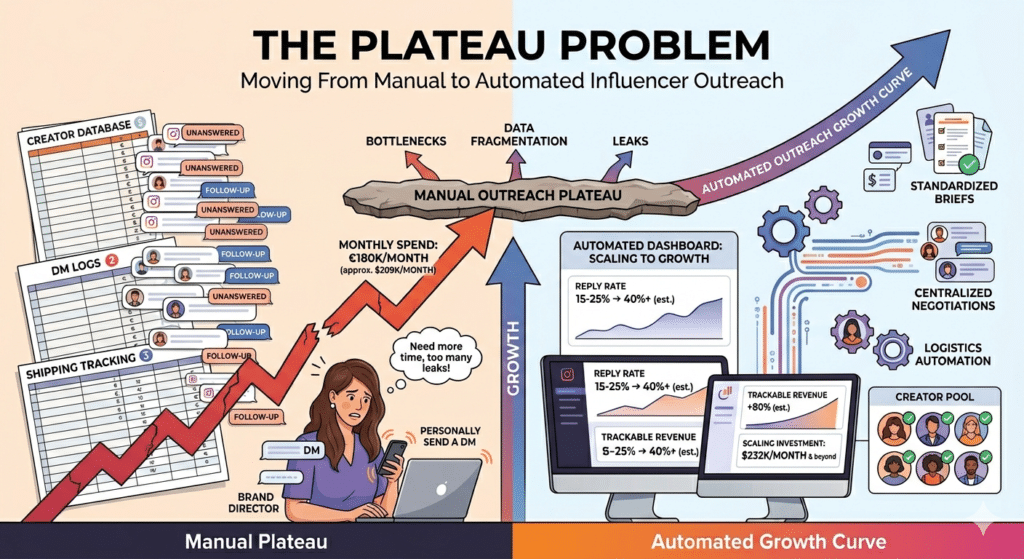
This infographic illustrates the common “Manual Outreach Plateau” that many brands hit when trying to scale. On the left, it visualizes the chaos of manual management, lost DMs, fragmented spreadsheets, and shipping tracking leaks, which eventually causes growth to stall despite increased spending. The right side showcases the “Automated Growth Curve,” where centralized negotiations and standardized briefs allow for a higher reply rate and significantly more trackable revenue.
Defining Influencer Outreach Automation (For Teams Who Already Do This Manually)
For teams already running influencer campaigns at scale, influencer outreach automation means something specific: orchestrated, multi-channel, templated, and data-driven creator outreach that operates as a repeatable system rather than individual heroics.
This includes several integrated components:
- Inbox infrastructure: warmed sending domains, smart routing, and DM workflows that prevent deliverability collapse as volume increases
- CRM logic: automated tags, relationship statuses, compensation tiers, and performance flags that move creators through stages without manual intervention
- Multi-channel sequences: coordinated touchpoints across email, Instagram DMs, TikTok, and LinkedIn that adapt based on creator response behavior
The contrast with generic blast lists is stark. In 2026’s crowded creator inboxes, dynamic personalization makes sense, referencing a creator’s recent video content, noting category fit, acknowledging regional audience overlap, or highlighting AOV alignment with your product. Without this context layer, even well-targeted outreach gets ignored.
The goal extends beyond reply rate. Pipeline health, the number of qualified creators moving from seeding through test posts into strategic collaboration, determines whether your influencer program compounds or stagnates. Treat creators as pipeline stages, not one-off transactions, and the economics shift dramatically.
Designing the Outreach Engine: Infrastructure Before Volume
Most brands try to scale outreach by sending more emails. This fails. Before adding volume, fix deliverability, domain architecture, and data hygiene, or watch 60–80% of messages land in spam.
Technical Sending Infrastructure
The infrastructure that supported top programs in 2024–2025 follows a consistent pattern:
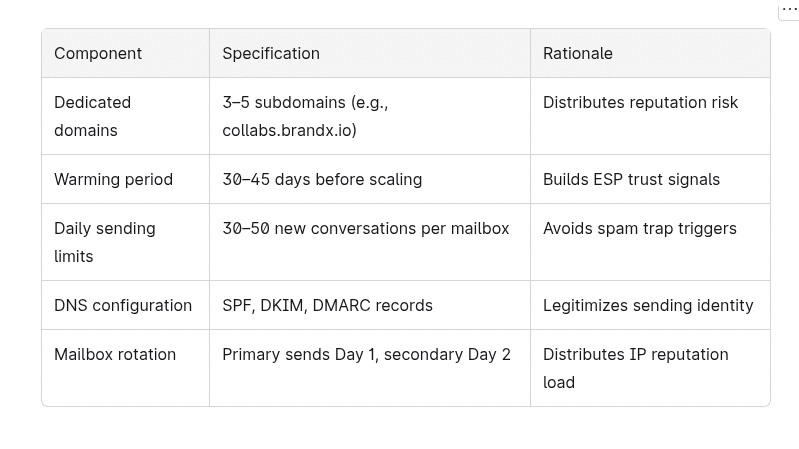
A single warmed domain safely handles 1,500–2,000 emails monthly. Brands targeting 3,000–5,000 monthly outreach attempts need 3–4 domains minimum. This isn’t optional, it’s ISP best practice.
Identity and Brand Safety
Creator inboxes are flooded with generic-looking outreach from suspicious addresses. Legitimacy signals matter:
- Clear sender names with real signatures: “Jane Chen, Creator Partnerships, [Brand Name]”
- Professional email signatures with brand logo, website, and social links
- Linked landing pages explaining the program upfront
- Legal footers with unsubscribe options and company address
Central Creator CRM
Your data foundation requires fields that automation tools can act on:
- Platform, niche, audience geography
- Past performance metrics (CTR, conversion rate, ROAS)
- Content format strength (short-form video vs. carousels)
- Usage rights history and relationship stage
- Last outreach date and response status
This data layer enables the dynamic personalization that separates ignored messages from accepted partnerships.
Segmentation & Targeting: Moving Beyond One Giant Outreach List
Automation’s power comes from segmentation. Blasting 5,000 undifferentiated emails is now ignored by serious creators in 2026 and it should be. The days of one giant outreach list are over.
Core Segment Framework
Effective programs operate across 3–5 core segments with distinct offers:
Nano Testers (5k–50k followers)
- Offer: Product seeding + 15–20% affiliate commission, no guaranteed fees
- Value prop: “Build your portfolio, full creative freedom, no strings attached”
- Volume target: 300–500 monthly outreach attempts
Micro Performance Partners (50k–250k)
- Offer: 20–30% commission + performance bonus if ROAS exceeds 3x
- Value prop: Repeat partnership potential, shared audience insights
- Volume target: 100–200 monthly attempts
Mid-Tier Hybrid (250k–1M)
- Offer: $2k–$7k fixed fee + 10–15% rev-share
- Value prop: Creator Council access, input on product development
- Volume target: 50–100 monthly attempts
Macro/Flagship (1M+)
- Approach: Warm introductions via manager/agent, not cold outreach
- Offer: Custom negotiation, 3–6 month partnerships
- Volume target: 5–15 highly selective attempts
Data Filters Within Segments
Beyond follower count, filter by:
- Audience geography and language alignment
- Historical CTR and conversion indicators from similar partnerships
- Content format strength matched to campaign needs
- Engagement quality (comment sentiment, not just rate)
- An authentic category fit a fashion creator promoting finance products signals low credibility
Finding creators who match your right audience across multiple dimensions reduces wasted outreach and increases acceptance rates by 2–3x.
Messaging at Scale: Guardrails Instead of Generic Scripts
Standard briefs are being ignored in 2026. But standardized messaging can still feel bespoke when built on modular templates and relevant context. The difference is architecture.
3-Layer Messaging System
Layer 1: Universal Program Framing: Who you are and what you do, 30 words maximum. Consistent across all segments.
Layer 2: Segment-Specific Value Prop How this helps their audience. Nano creators hear about creative freedom and portfolio building. Mid-tier creators hear about retainers and product input. Different segments, different hooks.
Layer 3: Personalized Hook What you noticed about them specifically. Reference a recent post’s engagement rate, mention shared audience overlap, or acknowledge their niche expertise. This layer requires data automation tools pull creator metrics, recent post IDs, and audience demographics to generate contextual hooks at scale.
Concrete Copy Guidance
- Subject lines: Under 45 characters. Use curiosity or specificity, not urgency or all-caps. “Quick question about your audience” outperforms “LIMITED TIME OPPORTUNITY!!!”
- Body structure: Hook in line 1–2, program context in lines 3–5, offer details in lines 6–8, explicit next step in lines 9–11
- CTAs: Be explicit. “Reply with ‘YES’ and I’ll send the full brief within 24 hours” beats “Let me know if you’re interested”
Creator-centric language focuses on their brand equity, long-term strategy potential, and clarity on usage rights. For fashion partnerships, emphasize co-creation opportunities. For wellness, lead with community impact and authentic testimonials.
Automation Flows: From First Touch to Long-Term Partner
Frame outreach automation as a funnel with discrete stages and automated transitions:
Prospecting → Seeding → First Test → Performance Review → Scale or Sunset → Creator Council
Typical Sequence Cadence
A proven 4–6 touchpoint sequence over 14–21 days:
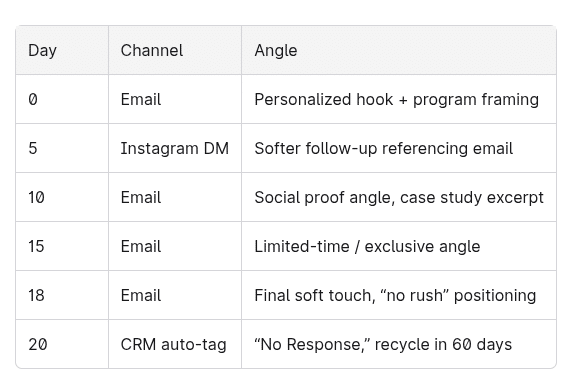
Behavioral Branching Logic
Different follow-ups for different signals:
- Opened but didn’t click: Send video testimonial or case study
- Clicked brief but didn’t reply: Direct CTA with limited-time offer
- Accepted seeding, uploaded within 7 days: Flag as “Fast Responder,” increase future commission offer
- Posted after 21 days: Tag as “Slow Responder” for tier adjustment
When a creator crosses performance thresholds—3+ ROAS over 30 days, for example, automated tasks trigger Strategic Partnership consideration. The CRM creates reminders for human review of high-performers, ensuring new creators who deliver results don’t get lost in the volume.
Timeline reality: Prospect to Activated Partner typically takes 90 days with automation. Without it, expect 4–6 months minimum.
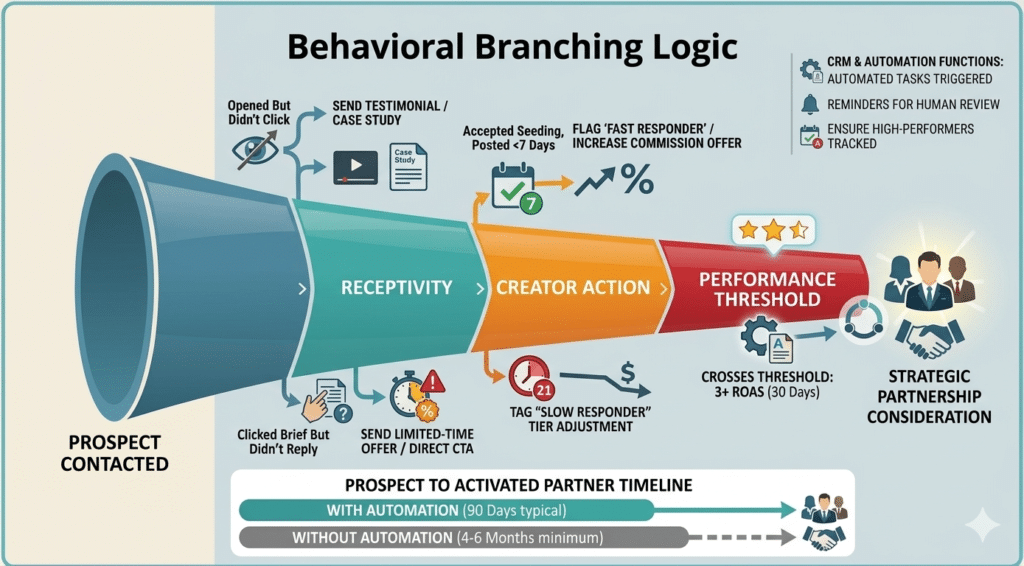
This diagram breaks down the “Prospect to Activated Partner” funnel, specifically highlighting how automation speeds up the timeline from months to weeks. It shows the “if/then” logic used to manage creators: if a creator is receptive but hasn’t replied, they receive a targeted follow-up; if they are a high-performer, they are automatically flagged for a strategic partnership. This systematic approach ensures no lead is dropped and high-value creators are prioritized for long-term growth.
Compensation Logic at Scale: Tiered Economics, Not One-Off Deals
Scaled outreach must connect tightly to a tiered compensation framework. Without it, negotiation overhead kills efficiency—and your small team spends too much money on back-and-forth instead of activation.
Baseline Rulesets by Tier
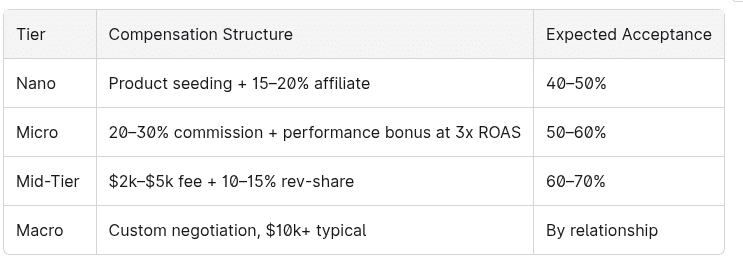
Embedding Tiers in Outreach
Comp tiers appear in outreach templates and landing pages so expectations are set upfront:
“For creators in your category (Fashion, 150k followers), our standard offer includes $2,500 guaranteed fee, 10% commission on attributed sales, full creative freedom, and 60-day exclusivity in fashion/apparel only.”
This transparency filters mismatched expectations immediately. Creators comfortable with the range proceed; others self-select out.
Dynamic Adjustment
- Upward: Creators generating LTV-positive cohorts (high repeat purchase, high AOV) earn 2–5% commission increases
- Downward: High refund rates or low-LTV audiences reduce tier in future campaigns
- Bonus triggers: $50k+ quarterly attributed revenue moves creators to “Hero” status with monthly retainer consideration
Quarterly performance reviews ensure non-performers sunset while top performers develop into long term partnership arrangements. This protects CAC and margin while keeping creators motivated through clear advancement paths.
Optimizing the Content Supply Chain: From Outreach to Always-On Creative
Shift from campaign-by-campaign thinking to a creative supply chain mindset. Outreach automation feeds content production, which feeds paid amplification, which compounds ROI.
Seed-to-Scale Pipeline
Phase 1: Bulk Seeding (Weeks 1–2) Ship product to 200–400 creators across nano and micro segments. No hard deadlines. Cost: product COGS only.
Phase 2: Performance Tiering (Weeks 3–4) Tag every seeded post with engagement metrics and sentiment. Top 5–10% flagged as “High Potential.”
Phase 3: Paid Conversion (Weeks 5–8) Offer high performers licensing deals: “$1,500 to license your video content for 60 days of paid social amplification.” Creator keeps organic post; brand runs paid version.
Phase 4: Paid Amplification (Weeks 9–24) Whitelisting and dark posting best-performing creatives into Meta, TikTok, and YouTube. Refresh every 2 weeks to avoid fatigue. Top 5–10 assets move to evergreen rotation.
Compounding Economics
Initial seeding generates 0.8–1.0x ROI on product cost alone. Add paid amplification of licensed content, and the same assets generate 2–3x ROI over 6+ months. A single piece of good content extends from a 2-week organic lifespan to a 6-month paid performance.
Weekly creative review meetings analyze top and bottom performers. What hooks work? What CTAs convert? Which video content formats are performed by platform? Insights feed back into creator briefs for the next cycle.
The Attribution Evolution: Measuring Automated Outreach Beyond Promo Codes
Most automated outreach programs still over-index on engagement and discount codes, missing the halo effect across other channels. When a creator generates awareness but the customer converts via paid ads two weeks later, the creator gets zero credit. This systematically undervalues influencer marketing by 30–50%.
Stacked Attribution Methods
Tier 1: Direct Response UTMs, trackable links, and promo codes capture immediate converters. Table stakes but incomplete.
Tier 2: Post-Purchase Surveys On order confirmation: “How did you hear about us?” with creator name options. Capture rate: 20–40%. Reveals customers who saw creator content but didn’t use codes.
Tier 3: Media Mix Modeling (MMM) Quarterly statistical analysis correlating all marketing spend with revenue. Output: “Influencer marketing drove 18% of total revenue despite 12% of spend.” This reveals actual impact across the full funnel.
Metrics That Matter at Scale
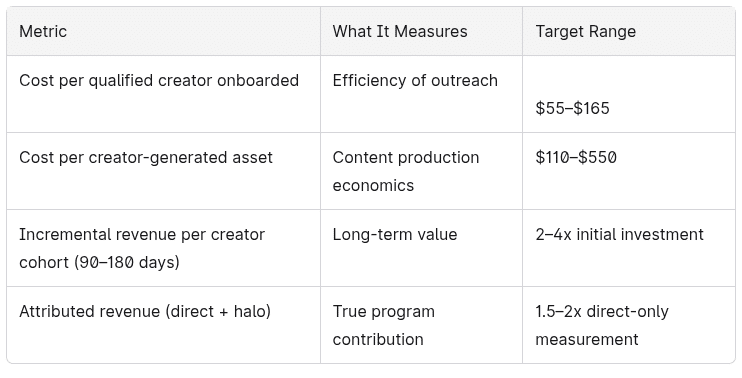
Identity-resolution friendly data matters: consistent campaign naming, creator IDs, and platform tags that roll into GA4, ad platforms, and BI tools. Without this discipline, attribution fragments and insights disappear.
The difference between measuring $70k (direct response only) and $155k (inclusive with MMM halo) changes budgeting decisions completely.
Institutionalizing the Program: SOPs, Brand Safety, and Creator Councils
Outreach automation only compounds if institutionalized through SOPs and governance rather than champion-dependent heroics. If your program collapses when one Brand Manager leaves, it’s not a system—it’s a dependency.
Key SOPs for $1M+ Annual Spend
- Outreach cadence documentation: Weekly targets, monthly volume goals, segment mix
- Escalation rules: If reply rate drops below 10%, pause outreach and audit templates
- Legal review cycles: Quarterly template review for claims, competitor mentions, and compliance
- Crisis response playbook: What happens if a creator generates negative press post-partnership
Guardrails, Not Scripts
Clear do/don’t lists protect brand safety while giving creators room to create authentic content:
DO: Reference recent posts, acknowledge authentic community voice, be transparent about usage rights upfront
DON’T: Make health claims, compare unfavorably to competitors, pressure creators on FTC disclosure (that’s their responsibility, but briefs should remind)
Sensitive categories (political content, medical claims, and financial services) require escalation protocols before outreach proceeds.
The Creator Council Model
Move from “vendors” to a long-term partnership with a curated group of top partners:
- Selection: Lifetime value >$10k, repeat rate >60%, audience alignment >80%, consistent ROAS >2x
- Structure: Quarterly video calls, monthly async updates, input on product development and campaign strategy
- Benefits: $2k–$5k monthly retainer, early access to products, equity/profit-sharing options, co-creation credit
Council members typically generate 3–5x more revenue than non-council creators. They become Strategic Partners who recruit other top-tier talent, effectively reducing your cost of acquisition for new high-performing creators.
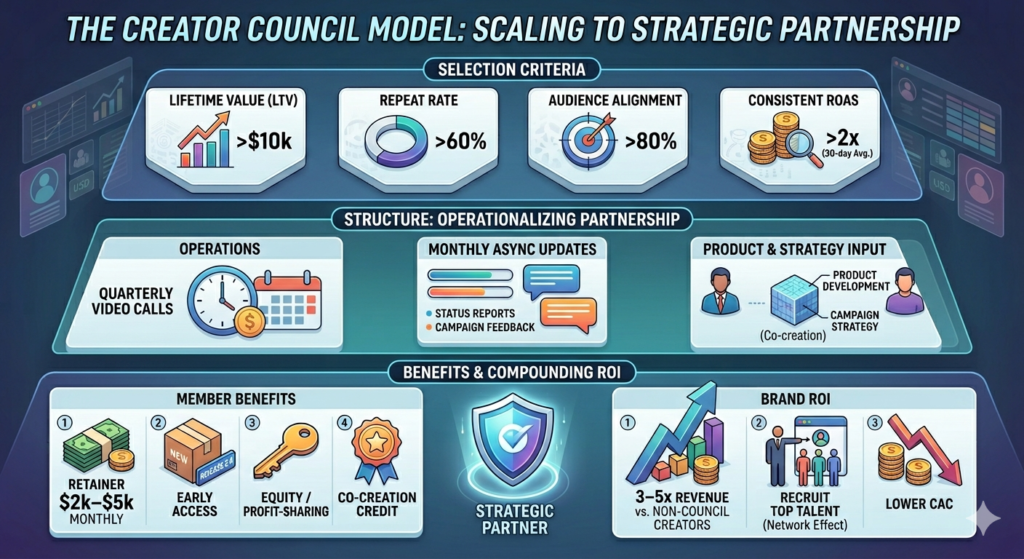
This visual outlines the transition from one-off transactional campaigns to a Strategic Partnership model. It defines the specific data-driven selection criteria, such as high repeat rates and consistent ROAS, required to move a creator into an elite “Council.” The middle tier demonstrates how the partnership is operationalized through quarterly strategy calls and product co-creation, while the bottom section highlights the compounding ROI for the brand, including lower Customer Acquisition Costs (CAC) and significantly higher revenue compared to non-council creators.
How InfluencerNexus Builds and Runs Outreach Automation for Mature Brands
InfluencerNexus works with brands already running 20+ influencer campaigns, helping them move from manual outreach chaos to a scalable growth engine. This isn’t beginner territory—it’s an agency partnership for CMOs and Brand Directors ready to systematize what they’ve already learned works.
Core Service Pillars
- Outreach infrastructure setup: Domain architecture, CRM configuration, sequence design, multi-channel workflow integration
- Segmentation and offer architecture: Data-driven creator tiers, compensation frameworks, landing page development
- Creative pipeline design: Seed-to-scale workflows, licensing systems, paid amplification integration
- Integrated attribution dashboards: GA4 integration, post-purchase survey implementation, quarterly MMM coordination
The agency combines AI-assisted targeting through leading influencer platforms with human strategist oversight to protect brand equity and ensure creator fit beyond surface metrics. Expertise in both automation tools and relationship management prevents the common failure mode of scaling volume without scaling quality.
InfluencerNexus audits existing influencer funnels, from seeding through paid amplification—to identify leaks: slow response times, misaligned comp tiers, non-attributed revenue, or creative fatigue in ad accounts. Most brands discover they’re leaving 20–40% of potential value on the table.
For brands already spending $115K–$345K monthly on creators, the path forward isn’t working harder. It’s building the system that lets you grow profitably without proportionally growing headcount.
FAQ
How many influencers should we be contacting per month once outreach is automated?
For brands already spending ~$231k/month, a reasonable starting target is 500–1,500 new outreach attempts monthly, depending on AOV, category saturation, and deal structure. Lower AOV products ($57.92 – $115.84) justify higher volume; higher-consideration purchases need more selective targeting.
Volume should scale only as fast as your team (or agency partner) can properly vet, brief, and measure creators. If downstream operations can’t handle 1,000 onboarded creators monthly, creative backlogs build and measurement suffers. Track reply rate (target 15–30%), acceptance rate (target 40–60%), and cost per activated creator as guardrails for when to increase or pause volume.
Which channels should we prioritize for automated outreach: email, DMs, or LinkedIn?
Email should be the backbone due to traceability, scalability, and deliverability control with warmed domains. It’s the channel where you can build sender reputation and scale to 1,000+ monthly touches without degradation.
Instagram and TikTok DMs serve as secondary touchpoints for highly relevant creators non-responsive via email—particularly younger creators who check DMs more frequently. LinkedIn is valuable for B2B influencer categories or when approaching creator managers, agents, and brand partnerships leads who treat LinkedIn as their professional inbox.
A practical multi-channel strategy: primary email (Day 0), secondary DM (Day 7 if no reply), tertiary LinkedIn (Day 14 for upper-tier or manager outreach). This captures 25–30% reply rates versus 15–20% for single-channel email alone.
How do we avoid damaging our brand reputation with mass outreach?
Strict targeting and opt-out hygiene form the foundation. Don’t message creators who clearly don’t fit your category a B2B finance brand messaging fashion nano-creators tanks reply rates and damages sender reputation. When a creator responds “not interested,” remove them from all future outreach for 12 months minimum.
Heavy personalization in first-touch templates for upper-tier creators signals respect and legitimacy. Clear transparency around expectations, compensation, and usage rights upfront filters mismatched expectations before they become complaints.
Quarterly audits of templates and sender reputations catch drift before it becomes damage. Monitor unsubscribe rates (should stay below 1%), survey creators on outreach quality, and adjust tone based on feedback patterns.
When does it make sense to build this in-house vs. partner with an agency?
In-house build makes sense for brands committed to hiring 1–2 full-time influencer operations roles plus data support, with a 12–18 month time horizon before full operational capability. Cost: $180k–$350k first year including hiring, tools, and training. Risk: system dependency on individuals who might leave.
Partnering with a specialist agency like InfluencerNexus is usually more efficient for brands already at $115k–$350k monthly creator spend who need faster deployment and proven playbooks. Timeline: 12 weeks to operational capability versus 12–18 months in-house.
The hybrid approach works well: agency sets up infrastructure and runs operations for 6–12 months while the brand builds internal capabilities, then transitions partially in-house with agency available for optimization and bigger campaigns.
How long before we see measurable improvements from outreach automation?
Set realistic expectations across two timeframes:
30–60 days: Operational gains visible—faster response times (2–6 hours versus 24–48), higher outreach volume (300–500 monthly automated versus 100–150 manual), lower manual overhead. These are process metrics, not yet revenue metrics.
90–180 days: Meaningful CAC and ROAS improvements emerge. CAC typically decreases 15–30% through better targeting and consistent process. ROAS stabilizes or improves 10–20% through improved creator fit. Revenue per creator increases 20–40% as compensation structures and creative pipelines mature.
Timing varies by vertical: beauty and fashion (fast purchase cycles) show results by day 60–90; high-consideration products and B2B take 180+ days. Establish a clear pre-automation baseline, activation rates, cost per content asset, revenue per creator, so improvements are quantifiable rather than anecdotal.