
Influencer Campaign Management: What Brands Should Expect from an Agency
Key Takeaways
- Modern influencer marketing routinely delivers $5–$6+ in revenue for every $1 spent when campaigns are architected for purchase, not just impressions (Source: Influencer Marketing Hub Benchmark Report 2025).
- “End-to-end” influencer campaign management means the agency owns strategy, creator selection, contracts, content, shoppable setup, analytics, and optimization all the way to tracked sales—not just matchmaking.
- Professional influencer agencies should set purchase KPIs from day one: ROAS thresholds, new customer revenue, cost per acquisition, and payback period.
- InfluencerNexus specializes in campaigns engineered around measurable outcomes rather than vanity metrics like follower count or engagement rates alone.
- This article shows exactly what serious brands should demand from an influencer campaign management agency in 2026 if they want measurable sales, not guesswork.
Introduction
In 2025, brands reported an average of roughly $5.78 in revenue for every $1 invested in influencer marketing, when those campaigns were properly measured to purchase (Source: Influencer Marketing Hub Benchmark Report 2025). That’s not impressions. That’s not likes. That’s actual buyer behavior converting into revenue.
Yet many brands still experience weak conversion from their influencer campaigns. Why? Because they’re treating influencer marketing as a series of one-off posts, picking creators based on aesthetics or follower count, and stopping their measurement at engagement instead of checkouts or subscriptions.
The solution is end-to-end influencer campaign management: an agency model where every stage, from campaign strategy and audience research through creator discovery, creative briefs, shoppable integrations, tracking, and post-campaign optimization, is explicitly tied to sales outcomes. This isn’t just finding pretty faces with big followings. It’s building a revenue engine.
At InfluencerNexus, we see this gap daily. As a B2B influencer marketing agency managing millions of dollars in campaign budgets each year, we know the brands who win are the ones that demand clear purchase KPIs, cost per acquisition, incremental revenue, repeat purchase rates and hold their agency partners accountable for delivering measurable results.
At InfluencerNexus, we manage millions in influencer campaigns every year with a sharp focus on purchase intention, here’s exactly what serious brands should expect when they want real revenue results.
What “End-to-End” Influencer Campaign Management Really Means for Purchase-Driven Results
When we talk about end-to-end influencer campaign management, we’re not talking about a glorified talent sourcing service. We’re talking about a full-service agency that owns the entire journey from brief to bank, every decision optimized for turning creator content into actual purchases.
Here’s what that lifecycle looks like when it’s wired for sales:
Strategy Phase
- Define concrete purchase KPIs: target revenue (e.g., $500K from a 90-day launch), ROAS thresholds (minimum 3x), blended CAC compared to paid social, and contribution to customer LTV
- Choose platforms based on how audiences actually buy—TikTok for Gen Z impulse purchases, YouTube for considered decisions, Instagram for visual discovery
- Design offer structures (discounts, bundles, free gifts) and ensure landing page alignment
Discovery Phase
- Filter creators not just on reach but on historic conversion data, promo code redemption rates, and audience behavior
- Segment into awareness creators vs. conversion creators based on where they fit in your funnel
- Prioritize creator vetting that surfaces actual purchase histories, not just high engagement
Execution Phase
- Negotiate contracts with affiliate or performance terms, usage rights for paid media amplification, and clear disclosure language
- Deploy shoppable elements: TikTok Shop, LTK links, Amazon Storefronts, Shopify-integrated links
- Manage content calendars, approval workflows, and real-time compliance
Measurement Phase
- Track every step: views → clicks → add-to-carts → purchases
- Unify platform data with GA4, UTM parameters, unique discount codes, and affiliate dashboards
- Generate performance data at the creator and content level, not just campaign-wide averages
Optimization Phase
- Run test-and-learn cycles on hooks, offers, and creator selection
- Scale winners into paid social, retail media, and email flows
- Build long term partnerships with top-performing creators for compounding returns
Practical Example: A DTC skincare brand launches a new serum over 8 weeks. Strategy sets a 4x ROAS goal on TikTok Shop. Discovery selects 50 micro influencers with 5%+ historical conversion rates. Execution deploys bundles with unique codes. Tracking reveals top 10 creators driving 70% of revenue. Optimization reallocates budget to them, achieving $1.2M revenue from $250K spend.
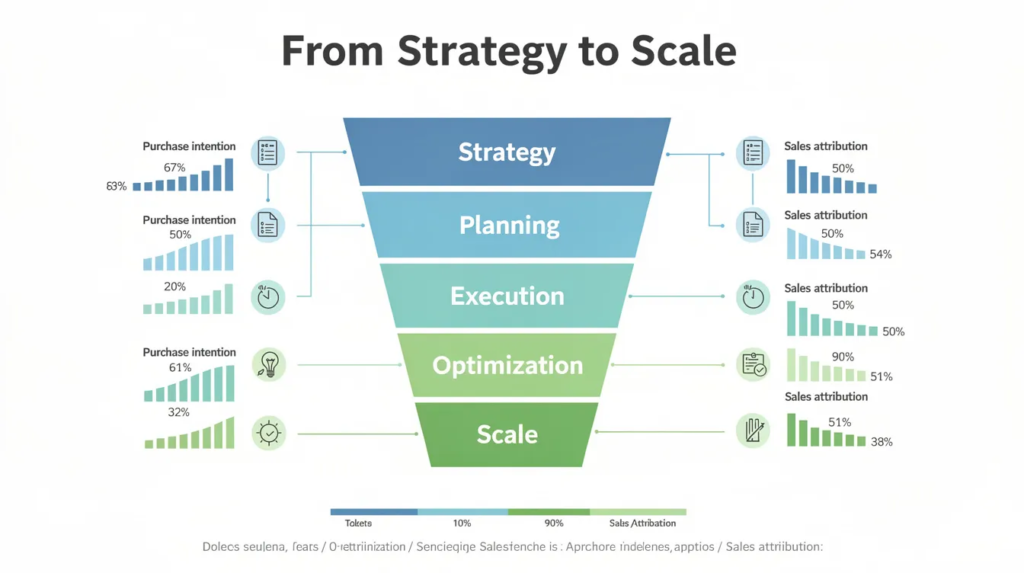
This infographic presents a five-stage business funnel, Strategy, Planning, Execution, Optimization, and Scale, that pairs each developmental phase with corresponding bar charts tracking purchase intention and sales attribution metrics to visualize growth performance.
The 8 Things Brands Should Expect from a Professional Agency When Purchase Intention Is the Goal
This is the core checklist: eight non-negotiable capabilities any influencer campaign management agency must demonstrate in 2026 if they’re serious about driving sales, not just reach.
Each section below covers what the agency does, how it affects purchase behavior, relevant benchmarks in US dollars, supporting data, and practical expectations or red flags.
1. Strategy & Goal Setting Centered on Purchase KPIs
If an agency starts the conversation with “how many influencers do you want?” instead of “how much revenue are you targeting?” walk away. The first step must be commercial goal-setting tied directly to your business outcomes.
At InfluencerNexus, we define concrete purchase KPIs before selecting a single creator: target revenue (e.g., $500K from a 90-day launch), ROAS (minimum 3x), blended CAC compared to paid social, and contribution to LTV from customers acquired via creators.
“Campaigns must be architected for purchase, not just impressions, routinely driving $5-6+ revenue per $1 when tied to sales tracking.” (Source: Influencer Marketing Hub 2025)
Strategic planning also includes offer structure, purchase friction (landing page speed, mobile UX), and post-purchase flows (email/SMS upsells) all of which impact conversion rates from influencer traffic.
Purchase-focused goal: “Generate 1,500 new customers at ≤$55 CAC with 4x ROAS.” Vague goal: “Increase awareness on TikTok.”
Red flag: If an agency only proposes KPIs like impressions and engagement rates without tying them to revenue or at least add-to-carts and email signups, they’re not practicing true end-to-end management.
2. Precision Influencer Discovery for High-Conversion Audiences
Choosing the right influencers isn’t about the prettiest feeds, it’s about finding the right buyers. Micro influencers (under 100K followers) routinely outperform celebrity influencers on cost-per-purchase because their audiences trust their recommendations.
A strong agency segments creators into awareness and conversion roles based on historical data: swipe-up click-through rates, promo code redemption, affiliate earnings per click, and frequency of commerce-focused content.
60% of brands report higher performance in sales metrics from micro-influencers versus celebrities (Source: Various 2025 agency reports aggregated in top agency lists).
The specific filters an influencer campaign management agency should apply include: audience demographics (location, income), retailer usage (Amazon, Walmart, Sephora), past brand categories, content sentiment, and creator consistency with product discovery content.
Example: Two creators have 80K followers each. Creator A has a 2% promo code from past campaigns. Creator B has gorgeous content but no tracked conversions. Choosing Creator B could double your cost per purchase.
Brand tip: Require that any creator recommendations come with historical benchmarks like “avg. $X revenue per post” or “Y% of tracked clicks convert” instead of vague claims about great engagement.
3. Transparent Negotiation, Contracting & Affiliate Setup for Sales Tracking
Contracts aren’t just legal paperwork, they’re the backbone of measurement and profitable economics when aligned with performance.
A professional agency negotiates rates based on value: usage rights for paid ads, whitelisting capabilities, exclusive coupon codes, affiliate or rev-share terms, and extra deliverables like vertical cuts for Reels and Shorts.
Average collaboration costs in 2025-2026: micro-influencer posts typically range $200-$500, while macro influencers command $10K+ per post (Source: Influencer Marketing Hub Benchmark Report 2025).
Affiliate tracking, via platforms like Impact, LTK, Shopify Collabs, or custom UTM + discount combos, is essential to see revenue at the creator and content level.
A professional agency ensures contracts spell out:
- FTC disclosure requirements
- Promo code structure and exclusivity
- Payment timelines
- Usage durations for content
- Clear expectations on shoppable links
Red flags: Agencies that avoid affiliate or performance components entirely, or that can’t explain how creators’ links and codes will be tracked back to sales inside your analytics stack.
4. Creative Briefs That Drive Purchase Intention
Creative direction is where campaigns often fail. Brands either over-script and kill authenticity, or under-brief and miss key purchase triggers like urgency and proof.
A strong purchase-focused brief includes:
- The core offer (discount, bundle, exclusive)
- 1–2 main value props
- 1–2 proof points (clinical results, reviews, before/after)
- Clear call to action tied to a specific link or code
Creator content drives 70% higher CTR than non-creator ads, directly lifting conversions (Source: Influencer.com 2025).
Briefs should be customized by platform and format, TikTok hooks under 3 seconds, YouTube mid-roll integrations, Instagram Reels mini-tutorials, while still giving creators creative freedom to speak authentically.
Mini-example: A brief for a CPG snack directs creators to highlight taste, convenience, and where to buy (Target, Walmart, DTC site), showing the product integrated into a real routine, not a scripted commercial read.
Brand tip: Expect to see test angles in briefs (problem-solution vs. social proof) so the agency can learn which creative narrative drives more purchases and scale the winner.
5. Seamless Campaign Execution with Compliance & Shoppable Elements
Campaign execution is the moment of truth. Operations can either support frictionless purchases or create leaks, missed links, wrong codes, and late posts that waste your marketing budget.
Tight execution includes:
- Central campaign calendars
- Approval workflows
- Content QA and link verification
- Same-day fixes when issues appear (broken UTMs, wrong landing pages)
In 2026, agencies should integrate directly with shoppable tools like TikTok Shop, Instagram Shopping, YouTube Shopping, Amazon storefronts, and retailer media programs to shorten the path from view to purchase.
Compliance matters: The agency must enforce FTC disclosure rules (#ad, paid partnership) to protect brand safety and avoid fines, which can hit six figures for serious violations.
Execution also considers inventory and promo windows, ensuring creators don’t drive demand when products are out of stock or when promo codes aren’t live. Both crush conversion and frustrate buyers.
Practical expectation: Brands should insist on a pre-launch checklist covering tracking, disclosures, links, and promo logic before any content goes live.
6. Real-Time Tracking of Engagement-to-Purchase Funnels
Shallow reporting sounds like: “Here are your impressions and likes.” Real funnel reporting looks like: creator by creator breakdown of clicks, sessions, add-to-carts, purchases, revenue, and ROAS.
An influencer campaign management agency connects platform data (views, watch time, saves) with analytics data (UTM-tagged sessions in GA4, revenue by source/medium, pixel events) and affiliate dashboards for a unified view.
Brands with stronger measurement practices achieve 80%+ of spend tracked to purchases, compared to 40% or less for in-house efforts (Source: 2025 Agency Performance Reports).
Real-time dashboards allow agencies to pause underperforming creatives, reallocate budgets to top converters, and quickly brief creators on winning hooks and offers.
Example: Tracking shows UGC-style “day in the life” videos drive $3.50 CPC but 6% conversion, while polished studio content has cheaper clicks but only 1% conversion. A smart agency shifts spend to the UGC format.
Red flag: If your agency can’t show you which creators are directly or indirectly driving revenue within the first 2–3 weeks of a campaign, attribution is likely too weak for serious budget deployment.
7. Fraud Detection to Protect Your Ad Spend and Sales ROI
Influencer fraud, fake followers, bought engagement, manipulated screenshots, directly inflates cost per purchase because spend goes to non-buyers.
A capable agency uses tools and manual checks to detect:
- Sudden follower spikes
- Mismatched engagement-to-follower ratios
- Generic or bot-like comments
- Traffic quality anomalies (high clicks but zero add-to-carts)
Fraud can inflate influencer costs by 15-20% or more, wasting significant portions of campaign budgets (Source: 2025 Industry Fraud Reports).
Beyond protecting media spend, fraud detection protects brand values. If real buyers realize creators are inflated or fake, trust and willingness to purchase drop sharply.
Practical expectations:
- Brands should receive a short fraud-risk summary with every recommended creator list
- Agencies should have a clear policy for replacing creators found to have questionable traffic or audience quality
8. Post-Campaign Analysis, Optimization & Scaling for Repeat Purchases
The best ROI happens over multiple waves when brands double down on what works. Post-campaign analysis unlocks that compounding effect.
A professional agency delivers a debrief covering:
- Top-revenue creators
- Best-performing hooks
- Winning offers
- Platform benchmarks
- Recommended next tests with projected ROI
Brands are increasing influencer budgets 25-30% year-over-year as they see consistent ROI from disciplined optimization (Source: Influencer Marketing Hub 2025).
Scaling often means moving top creators into longer-term retainers, adding performance incentives, turning best content into paid ads, and building creator whitelisting programs across Meta, TikTok, YouTube, and retail media.
Analysis should also examine downstream metrics: repeat purchase rate, subscription retention, and uplift in branded search to see full-funnel profit.
Practical tip: Expect clear “If we invest $X more based on this campaign’s learnings, we project $Y–$Z in additional revenue” recommendations, not just retrospective reporting.
Real Numbers: What Purchase-Focused Brands Are Spending and Earning in 2026
Understanding the current market helps brands plan their influencer strategy with realistic expectations. Here are the key figures shaping 2025-2026:
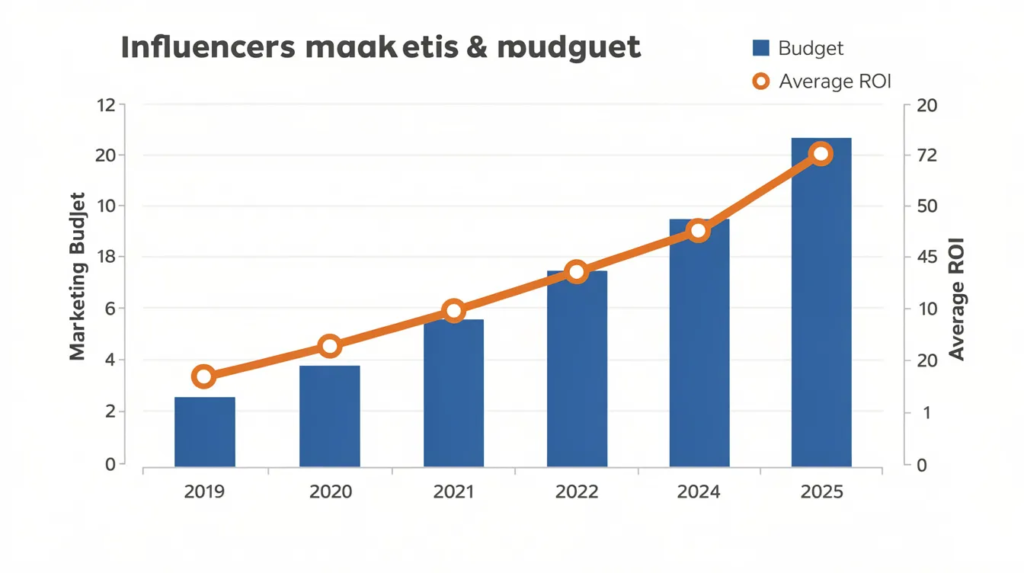
- Global influencer marketing market size: $32.55B in 2025, projected to exceed $40B by 2026 (Source: Influencer Marketing Hub Benchmark Report 2025/2026)
- Average ROI: $5.78 revenue per $1 spent when measured to purchase (Source: Influencer Marketing Hub 2025)
- US brand spend: Mid-market brands typically allocate $1-5M annually to influencer marketing (Source: Industry Reports 2025)
- Average collaboration cost: Around $202 for micro-influencer posts; macros $10K+ (Source: Influencer Marketing Hub 2025)
- Budget growth: 25-30% year-over-year increases as payback periods shorten to 3-6 months (Source: Industry Benchmarks 2025)
- Micro-influencer performance: 2-3x better ROAS on purchases versus celebrity partnerships (Source: Agency Reports 2025)
These numbers reflect confidence in sales outcomes. Faster payback periods make influencer channels competitive with paid social and search.
In-House vs. End-to-End Agency Comparison
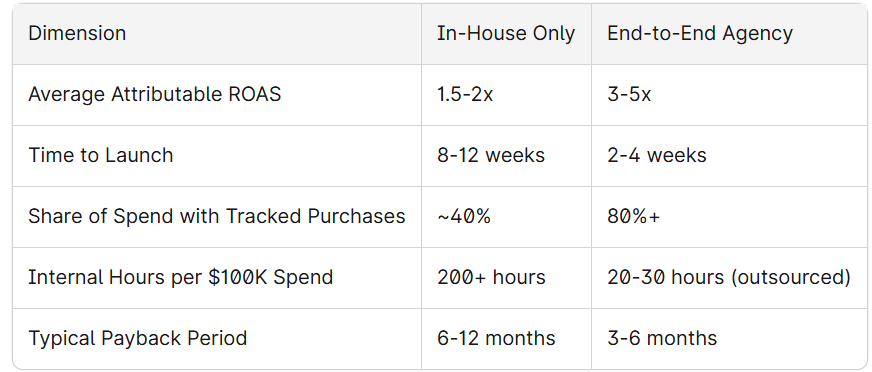
The question isn’t “How cheap?” but “How reliably can we turn $1 into $4–$6+ in tracked revenue?”
Common Pitfalls That Kill Purchase Intention in Influencer Campaigns
Even with so many agencies available, many brands still fail to drive purchases from their influencer content. Here are the most common mistakes:
- Misaligned creator selection: Choosing purely by follower count or aesthetics leads to low click quality and poor conversion. The creator’s audience may love the content but have zero intent to buy.
- One-off, single-post campaigns: Most buyers need 3-7 touchpoints before purchasing. Single posts rarely move the needle, multi-wave campaigns with frequency drive 5-10x better conversion than one-offs.
- Weak tracking: Without UTMs or unique codes, it’s impossible to calculate ROI or justify continued investment. 40% of influencer spend goes untracked without proper agency support—leading to budget cuts even when campaigns might have worked.
- Over-controlling content: Ignoring creator insight and over-scripting typically reduces authenticity and crushes purchase intention by up to 40%, especially in trust-sensitive categories like beauty, wellness, and food.
- Ignoring landing page and offer quality: Even the best creators can’t fix slow sites, confusing checkout, or weak offers. High click-through with almost no purchases usually signals friction after the click, not creator failure.
How to Choose an Agency That Delivers Strong Purchase ROI
With so many agencies claiming expertise, brands need a practical way to separate the best agencies from those who deliver vague claims without business outcomes.
Here are 7 questions to ask when choosing an influencer marketing agency:
- “How do you design campaigns around purchase KPIs, not just engagement?”
- Strong answer: Specific mention of ROAS targets, CAC benchmarks, revenue tracking
- Weak answer: Focus on reach, impressions, “brand love”
- “Can you walk us through a campaign where you improved ROAS between waves?”
- Strong answer: Specific numbers, test-and-learn process, optimization steps
- Weak answer: Generic success stories without conversion data
- “What tools do you use to connect creator activity to sales?”
- Strong answer: UTMs, GA4 integration, affiliate platforms, promo codes, pixel tracking
- Weak answer: “We track engagement” with no sales attribution
- “How do you decide which creators should be on performance or affiliate terms?”
- Strong answer: Based on historical conversion data and creator selection criteria
- Weak answer: “We negotiate flat fees with everyone”
- “How do you handle fraud detection?”
- Strong answer: Specific tools, manual audits, replacement policies
- Weak answer: “We work with trusted creators”
- “What does your post-campaign debrief include?”
- Strong answer: Revenue by creator, winning hooks, data driven insights for future campaigns
- Weak answer: Impressions and engagement summary only
- “Can you share anonymized case studies with spend, revenue, and ROAS?”
- Strong answer: Concrete numbers and brand alignment examples
- Weak answer: Vague references to “great results”
At InfluencerNexus, we welcome these questions. Our end-to-end services include an integrated data stack, AI-assisted discovery with human vetting, and narrative-driven campaigns that consistently tie back to purchase KPIs.
What Purchase Success Looks Like: An InfluencerNexus Campaign Example
A mid-market DTC beauty brand came to InfluencerNexus with a challenge: paid social ROAS had plateaued at 1.8x, and they needed a new channel to drive an additional $500K in Q4 revenue.
We started with campaign goals and brand objectives: 4x minimum ROAS, maximum $60 CAC, and focus on new customer acquisition. Platform behavior analysis pointed to TikTok and Instagram as primary channels based on their target audience’s shopping patterns.
Our creator sourcing identified 45 creators segmented into awareness (larger reach, brand story focus) and conversion (proven promo code redemption, commerce content history). Contracts included affiliate terms, exclusive codes, and usage rights for paid amplification.
Creative briefs focused on before/after demonstrations, ingredient proof points, and limited-time bundle offers. We deployed content in two waves, using performance tracking to identify top performers mid-campaign.
Results:
- Total influencer spend: $200K
- Total tracked revenue: $900K
- ROAS: 4.5x
- New customers acquired: 1,500
- CAC: $55 (vs. $85 from paid social)
The top 10 creators drove 65% of revenue. We moved them into longer-term retainers for future campaigns.
“InfluencerNexus turned influencer into a 4.5x ROAS channel for us within one quarter. We finally have a performance channel that measures performance beyond likes.”, Anonymized DTC Beauty Brand, Q4 2025
Learnings from this campaign, winning hooks, top creator profiles, optimal offer structures, informed the Q1 wave, projecting even higher returns as creator relationships compound.
FAQ
How long does it usually take to see sales from an influencer campaign?
First purchases typically appear within days of launch when tracking and offers are properly set up. However, meaningful ROI assessment usually requires 4–12 weeks, depending on product price point and buying cycle.
Learning cycles, testing creators, hooks, and offers, mean purchase performance often improves across successive waves. End-to-end agencies like InfluencerNexus design campaigns to start measuring purchase behavior immediately, building data from day one rather than waiting months for insights.
What budget do we need to work with an influencer campaign management agency focused on purchases?
Brands typically see meaningful test results when investing at least $30K-$50K in total campaign costs (creator fees plus agency fees). Larger brands often allocate six- or seven-figure annual budgets.
The important question isn’t only total spend but whether enough budget exists to test a portfolio of creators and creative angles. InfluencerNexus usually recommends planning for multiple waves rather than a single one-off test if the goal is building a reliable revenue channel.
How is influencer campaign management different from just hiring influencers through a platform?
Self-serve platforms help you find and pay influencers, but they rarely design influencer strategy, ensure high-quality creative, set up shoppable journeys, or measure revenue accurately across channels.
A campaign management agency is accountable for sales KPIs, not just introductions. We act like a performance marketing partner using creators as the primary media channel. InfluencerNexus integrates influencer work with landing pages, email, paid media, and analytics so every piece of content has a defined role in driving purchase intention.
Can influencer campaigns drive both awareness and sales at the same time?
Yes, a well-structured program can do both. But the creative, creator mix, and measurement must be designed intentionally so purchase-focused creators can be evaluated separately from pure awareness plays.
Many top-performing programs run a “barbell” strategy: some creators build cultural relevance and top-of-funnel excitement while others are selected specifically for their ability to convert warm audiences into buyers. A strong agency rolls everything into a unified view of revenue, ROAS, and incremental lift.
How do influencer campaigns fit with our existing paid social and search efforts?
Influencer functions as a complementary acquisition and conversion engine. It can lower creative fatigue in paid social and create trusted touchpoints before a search or retargeting click.
An end-to-end agency coordinates creator content with Meta, TikTok, YouTube, and Google campaigns, often turning top-performing influencer posts into high-ROAS paid ads and retargeting visitors who came from creators. InfluencerNexus routinely works alongside in-house and external performance teams to ensure influencer-driven purchases show up cleanly in blended reporting.
Conclusion
In 2026, “influencer campaign management” must mean a full-funnel, purchase-driven strategy, not simple influencer matchmaking. The brands winning are those who demand their agency own the entire journey from brief to bank: strategy, creators, contracts, content, tracking, optimization, all reported in revenue terms, not just reach.
The creator economy has matured. Platform trends point toward integrated commerce. The right influencer marketing agency transforms influencer partnerships from a fuzzy awareness play into one of the most profitable lines on your marketing P&L.