

Key Takeaways
- Average influencer campaign ROI sits around $5.20–$5.78 per $1 spent in 2026, but top brands hit $11–$18+ by measuring beyond vanity metrics like likes, impressions, and follower counts.
- Experienced brands now treat influencer programs like any other performance channel, tracking attributed revenue, multi-touch ROAS, incremental lift, CAC, customer lifetime value, and payback period.
- Moving from manual spreadsheets and last click attribution to AI-driven influencer attribution unlocks faster optimization and defensible budget conversations with CFOs.
- InfluencerNexus and [Your Product Name] help brands already running influencer campaigns turn scattered data into a single source of truth for influencer ROI.
- This article includes advanced tactics (incrementality tests, multi-touch attribution models, AI scoring) plus real 2026-style case studies and a clear next step: your ROI audit demo.
You’re Already Investing, But Are You Measuring What Actually Matters?
In 2026, most brands already spend 15–25% of their social budgets on influencer marketing. Yet when quarterly reports land, many marketing teams still present likes, views, and follower growth to leadership, metrics that look impressive but say nothing about revenue.
Industry data shows average programs yield $5.20–$5.78 in revenue per $1 spent. Despite this, 56–60% of marketers in recent surveys cite “measuring influencer ROI” as their primary challenge. The vanity metrics trap persists even among experienced teams.
What exactly are vanity metrics? Impressions, likes, raw reach, and follower counts. They inflate perceived success without linking to cash flow. Experienced teams know these are insufficient, but remain stuck due to siloed data across platforms, manual CSV exports, and Google Analytics reports using last-click that under-credit creators who drive awareness.
The pain points are familiar: decks full of screenshots, weekly exports from Instagram and TikTok, and no clear answer when the CFO asks about incremental revenue. The gap between average and top-tier influencer ROAS isn’t primarily a creative problem; it’s a measurement problem. Solving it requires a modern measurement framework that ties influencer content to real business outcomes.
What Real Influencer Campaign ROI Looks Like for Active Brands in 2026
Defining influencer campaign ROI properly means using the same financial terms applied to Meta, Google, and programmatic: revenue generated, profit margin, and payback period, not engagement rate alone.
Core metrics that sophisticated brands track include:
- Attributed revenue per campaign and per creator. Connecting each influencer post to actual purchases
- Multi-touch ROAS across 30–90 day windows. Capturing delayed conversions and the full customer journey
- Incremental sales lift vs. control. Isolating true business impact from baseline
- CAC from influencer-sourced customers. Comparing customer acquisition costs across channels
- CLV and 6–12 month retention for influencer cohorts. Measuring lifetime value, not just first purchase
- Payback period on influencer spend. Many brands aiming for under 30 days
Benchmark ranges for 2026:
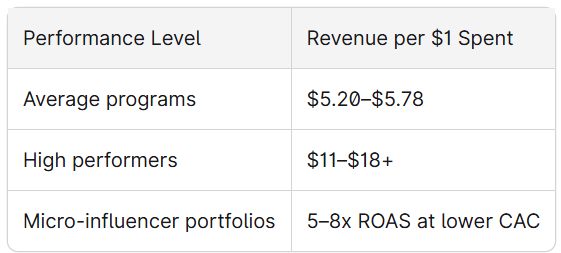
These performance metrics differ from vanity metrics in three critical ways:
- They connect directly to cash flow, margin, and future pipeline.
- They enable apples-to-apples comparison with paid social and search.
- They provide defensible data for CFO conversations about influencer fees and budget allocation.
InfluencerNexus builds these metrics into every campaign strategy and reporting stack, helping brands benchmark against industry benchmarks and forecast future performance with confidence.
5 Advanced Ways Experienced Brands Measure and Optimize ROI
If you’re already running influencer campaigns, this playbook moves you from generic Google Analytics reports to sophisticated influencer measurement that proves business impact.
1. Unique Promo Codes + UTM Layering with Platform Pixels
Combine creator-specific links, unique promo codes, and first-party pixels for comprehensive tracking. A 2026 example: layer UTMs (utm_source=influencer&utm_campaign=creatorname&utm_medium=tiktok) with TikTok Spark Ads on organic influencer posts, capturing 20–30% more conversions via view-through windows of 15–30 days.
Common pitfall: Codes shared in group chats inflate redemptions by 10–20%. Fix: Cross-check with view-through data and post-purchase surveys asking “How did you hear about us?” to achieve 85% attribution accuracy.
2. Multi-Touch Attribution Models (Beyond Last-Click)
Last click attribution underestimates top-of-funnel influencer activity by 40–60%. Influencer partnerships often drive brand search and awareness that converts later through other channels.
Consider these models:
- Linear: weights all touchpoints equally across multiple touchpoints
- Time-decay: favors recent touchpoints (e.g., 40/30/20/10% distribution)
- Position-based: 40% first touch, 40% last, 20% middle
Common pitfall: Using a single default model for all categories. Fix: Tailor your attribution window to buying cycles, 7 days for impulse CPG, 45–60 days for beauty, 90+ days for wellness.
3. Incrementality Testing (Control Groups, Geo-Lift)
Run city-level or DMA-level holdout tests. For a Q2 2026 launch, activate influencer campaigns in 8 test markets while keeping 8 matched markets as controls. Measure 60–90 day sales lift.
Compute incremental ROAS: (Exposed Revenue – Control Revenue) / Cost. A lift greater than 20% signals genuine influencer impact beyond baseline.
Common pitfall: Overlapping promos muddy 30% of signal. Fix: Coordinate test calendars with performance marketing teams for statistical significance at p<0.05.
4. Unified Dashboards Connecting Social, Site, CRM, and Affiliate Data
Pull platform metrics, Shopify checkout data, CRM events from HubSpot or Klaviyo, and affiliate network results into one view via CRM integration and API connectors.
Common pitfall: Manual spreadsheet exports once weekly lose 20% data freshness. Fix: Use API-based connectors for real-time views. InfluencerNexus replaces ad-hoc dashboards with automated, AI-powered influencer attribution.
5. AI-Driven Content Performance Scoring and Creator Optimization
Score each post by blended KPIs: click-through rate, add-to-cart, conversion, CAC, ROAS, and retention rate. Internal benchmarks show that tutorial-style TikTok content from mid-tier creators yields 7.4x ROAS, compared with 3.2x for aesthetic-only content.
Common pitfall: Selecting creators based on aesthetics or follower counts (correlation with ROI is under 0.3).
Fix: Use AI scores based on historical performance and overlap in audience demographics (target 70%+) for predictive optimization.
InfluencerNexus runs these methods at scale internally. This eliminates manual reporting while significantly improving campaign performance.
Real Results: How Brands Scaled Their Existing Influencer Programs
These anonymized 2024–2026 cases show what happens when brands upgrade measurement instead of just increasing spend.
Case Study 1: DTC Beauty Brand (US, 2024–2025)
A mid-sized skincare brand spending ~$150K/quarter on influencers across TikTok and Instagram.
Before: Manual tracking, last-click attribution, ~2.8x reported ROAS, high variance across creators, difficulty justifying budget increases, 41-day payback period.
After implementing advanced measurement systems:
- 90-day multi-touch model revealed true 5.9x influencer ROAS
- 64% reduction in blended CPA by cutting 27% of low-quality influencers
- Attributed revenue from influencer campaigns doubled within two quarters, at only 18% higher spend
- Payback period improved to 19 days, unlocking finance approval for 40% budget increase
Case Study 2: Consumer Subscription Brand (EU + UK, 2025–2026)
A subscription-based wellness app with physical product bundles, running always-on influencer deals across DE/UK/FR markets.
Before: Influencer treated as “brand marketing” channel with no hard revenue attribution, ~3.1x estimated ROAS, influencer CAC perceived as higher than Meta.
After AI-driven attribution and incrementality testing:
- Geo-lift tests across 10 EU markets showed 19% incremental sales lift in exposed regions
- Influencer-acquired customers displayed 27% higher 12-month CLV and 15% higher repeat purchase rate versus paid-social cohorts
- Program stabilized at consistent 7x+ ROAS with influencer CAC 18% lower than paid social
- Reallocation of $275K per quarter from Meta into high-performing creator partnerships.
These results transformed internal conversations. Marketing teams walked into QBRs with cohort curves, incremental ROAS charts, and creator-level profit reports instead of engagement screenshots, making the budget conversation far more productive.
What Industry Leaders Say About Moving Beyond Vanity Metrics
By 2026, CMOs, performance leads, and C-suite executives will align on one thing: influencer marketing must meet the same standard as every other media investment.
“The pay-for-reach era is dead — ROI is king.”
Brands no longer pay just for follower counts; they pay for attributable revenue and profitable audience growth.
“Brands now expect full-funnel reporting, including incremental reach and direct performance indicators.”
Reporting must span from awareness (brand lift) to conversions (ROAS, CAC) in a single integrated view.
“Influencer marketing delivers 11 times the ROI of traditional digital advertising when properly measured.”
Well-measured programs with proper earned media value tracking outperform display and generic social ads on a revenue-per-dollar basis.
“If the goal is sales, track add-to-cart, purchases, and ROAS, not just engagement.”
Engagement without downstream purchase intent is now treated as a warning sign, not a success metric. Engagement quality matters more than engagement signals alone.
InfluencerNexus designs campaigns and reporting around these same principles, tying creative storytelling to measurable business outcomes and real ROI.
How InfluencerNexus Turns Your Existing Campaigns Into Measurable Revenue Machines
InfluencerNexus is an AI-powered attribution and analytics platform built specifically for brands that are already investing in influencer campaigns.
It is not designed for beginners who are still exploring basic influencer discovery or selection.
Key benefits for experienced users:
- Seamless stack integration: Connect Shopify, WooCommerce, Meta/TikTok/YouTube APIs, CRM, and affiliate platforms without rebuilding tracking from scratch
- AI-driven auto-attribution: Combine UTMs, pixels, view-through data, and promo codes to assign revenue fairly, eliminating last-click bias across the customer journey
- Real-time ROI dashboards: Replace weekly spreadsheets with on-demand creator-level ROAS, CAC, and payback metrics
- Built-in incrementality insights: Geo-lift and audience holdout options prove true added value to finance and leadership
- Creator ranking by true ROI: Double down on profitable partners and exit underperformers, not based on engagement rate but actual influencer performance
- AI content scoring: Identify which formats and storylines drive add-to-cart and purchases, informing briefs and cultural relevance
- Cohort reporting: Compare influencer-acquired customers’ CLV and retention to other channels for sophisticated budget allocation
- Privacy-first measurement: Respects iOS 14.5+ restrictions using first-party data and modeled attribution
InfluencerNexus uses its own advanced systems across all done-for-you client campaigns.
This gives brands access to a senior strategy team and a robust measurement engine that strengthens the brand’s presence in the market.
Conclusion: Measure Influencer Campaign ROI Like a Top Performer
You’re already investing real budget in influencers. The average ROI is strong on paper, but without precise measurement, you’re likely under-investing in what truly works and overpaying for noise from fake followers and low-engagement content.
Moving beyond vanity metrics to accurately measure influencer campaign ROI, attributed revenue, incremental lift, CLV, and payback is now the baseline for 2026 marketing teams with business objectives tied to website traffic and total campaign cost efficiency.
InfluencerNexus delivers both strategic guidance and an AI-powered measurement layer to hit $11–$18+ ROAS tiers without adding internal reporting burden.
Ready to see exactly which creators and content drive your revenue?
Book a personalized ROI audit demo and uncover hidden profit in the influencer campaigns you’re already running.
FAQ: Measuring Influencer Campaign ROI in 2026
These are common questions sophisticated teams ask when transitioning from vanity metrics to full-funnel influencer attribution.
How long should I run attribution windows for influencer campaigns?
Tailor attribution windows by category:
- 14–30 days for impulse CPG
- 30–60 days for fashion
- 60–90+ days for beauty and wellness
Too-short windows undercount revenue because many brands miss delayed conversions that occur after initial awareness. Modern tools let you adjust windows dynamically based on your specific purchase cycle data.
How do I compare influencer ROAS to Meta and Google fairly?
Normalize to the same ROAS and CAC definitions across channels. Include incremental lift where possible, and examine customer lifetime and retention, not just first-order revenue. Many brands find influencer-acquired customers show 20–30% higher CLV, changing the comparison dramatically.
What if most of my influencer impact is offline or cross-device?
Use post-purchase surveys asking “How did you discover us?”, track brand search lifts in Google Analytics, and leverage modeled attribution to capture effects that don’t pass through trackable links. These methods recover 20%+ of otherwise invisible influencer impact.
How many influencers do I need for statistically meaningful tests?
Aim for at least 10–20 creators per wave or a minimum of 100K impressions per test group for mid-sized brands. [Your Product Name] helps estimate required sample sizes based on your historical variance and business impact goals.
Can I implement this measurement framework without switching my entire tech stack?
Yes.
Modern tools layer onto existing e-commerce, analytics, and CRM setups via APIs. It’s an evolution, not a rip-and-replace—designed for brands already running sophisticated operations who want better influencer measurement without a sudden spike in workload.